
Vanuatu’s Cacao Revolution
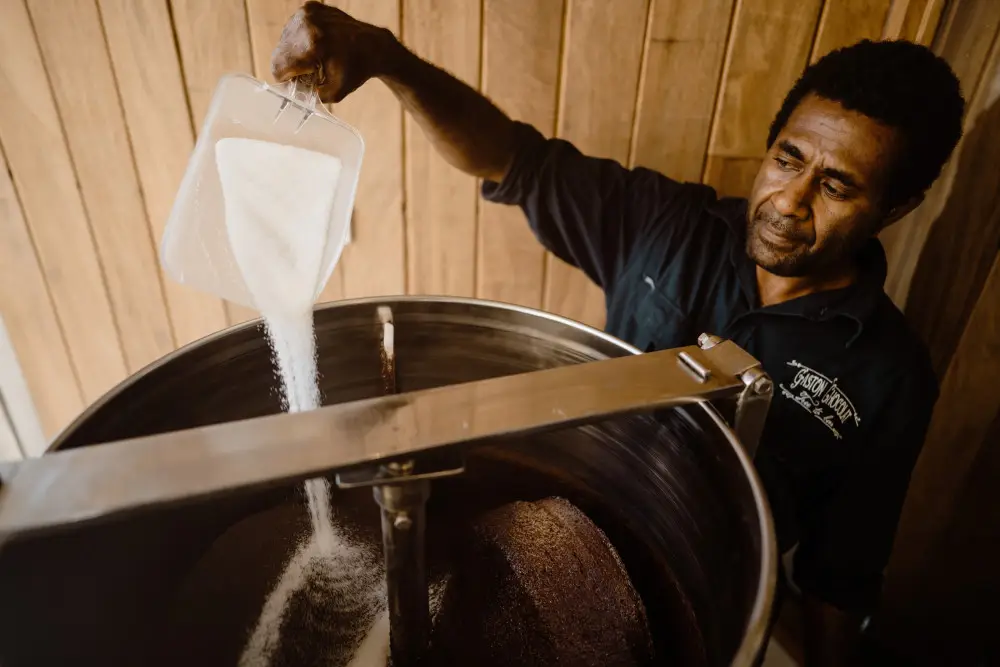
What started as a passion project to highlight Vanuatu’s rich cacao heritage has transformed into a thriving business for Gaston Chocolat exporting award-winning chocolate to Australia and New Zealand. But behind the success of Gaston Chocolat is a story of hard work, dedication, and the support provided by PACER Plus. Founded by Olivier Gaston, Gaston Chocolat was born from a simple idea: to produce world-class chocolate locally in Vanuatu while showcasing the country as a premium origin for fine cacao. But turning that vision into reality came with its challenges, especially when it came to meeting international food safety standards—a necessary step to export to larger markets. That’s where PACER Plus stepped in. In 2023, Gaston Chocolat exported 17 tonnes of dried cacao. This year, they’re on track to export 60 tonnes—almost a fourfold increase. In collaboration with the Vanuatu Chamber of Commerce and Industry and the Australia Vanuatu Governance for Growth program, PACER Plus engaged local consulting firm Quality Solutions to help Gaston Chocolat develop food safety systems. The goal was to achieve Hazard Analysis and Critical Control Point (HACCP) certification—a globally recognised standard that would open the doors to international trade. For Olivier Gaston and his team, the certification was a game-changer. “The HACCP certification shows that our operation is up to international standards,” says Mr. Gaston. “This way, people can trust the product. Because our chocolate can now travel to Australia and New Zealand, we can sell the cacao on a much larger scale to chocolate makers.” And the results speak for themselves. In 2023, Gaston Chocolat exported 17 tonnes of dried cacao. This year, they’re on track to export 60 tonnes—almost a fourfold increase. “That’s almost fifteen percent of the national market, and we’re quite proud of that achievement,” Mr. Gaston adds. But Gaston Chocolat’s impact goes beyond just business success. The company has built a network of 367 Ni-Vanuatu farmers, training them over the last decade to grow and harvest high-quality cacao. In 2024 alone, the farmers have been harvesting for a total of 57 days. And the rewards have been significant. Gaston Chocolat has built a network of 367 Ni-Vanuatu farmers, training them over the last decade to grow and harvest high-quality cacao. “Our farmers now earn the equivalent of twice the minimum wage by working just one day a week,” says Mr. Gaston. “Because we create jobs in the islands that pay more than the jobs in Vanuatu’s capital, Port Vila, we are fighting the urban drift. We’ve proven that rural jobs can pay better than city jobs.” Gaston is driven by more than just profits. “We are always conscious about looking after our staff well, respecting the culture, and considering our environmental impact,” he explains. “I want to run Gaston Chocolat sustainably, and I want everyone in the supply chain to benefit from the business and improve their standard of living.” More articles like this one
From Cacao Beans to Fruity Bars

Cathliro Commodities, a women-led, locally owned cocoa producer and exporter in Solomon Islands, has taken a significant step forward in its operations with the recent handover of a food dehydrator machine. The equipment, officially delivered in September 2024 and funded by the PACER Plus Development and Economic Cooperation (DEC) Work Programme, is set to enhance the company’s ability to produce value-added cocoa products and diversify into dried fruits. This support marks a turning point for the small business, which has become a beacon of hope for local farmers and a rising player in the international cocoa market. Diana Yates (far left), Cathliro Commodities founder, with Collin Beck (second from left), Permanent Secretary of Solomon Islands’ Ministry of Foreign Affairs and External Trade at the dehydrator handover along with Natalia Patternot (third from left), Director of Department of External Trade and Tristein Zutu, PACER Plus National Coordinator Solomon Islands. Cathliro Commodities was founded by Ms. Diana Yates, a determined entrepreneur with a vision to elevate Solomon Islands’ cocoa industry. Her 99-hectare cocoa farm, based in Guadalcanal, has been instrumental in connecting local farmers from nearby provinces, including Isabel and Makira, to international markets. The company purchases cocoa beans from over 200 local growers, transforming these raw materials into high-quality cocoa products for export. But the company’s ambition doesn’t stop there—Cathliro is diversifying its product line to include dried fruits like pineapple, banana, and pawpaw, a move that the new dehydrator will help realise. Speaking at the handover ceremony, Permanent Secretary of the Ministry of Foreign Affairs and External Trade (MFAET), Mr. Collin Beck, emphasised the significance of empowering local producers like Cathliro Commodities. The PACER Plus-funded food dehydrator machine is set to enhance Cathliro’s ability to produce value-added cocoa products and diversify into dried fruits. “Cathliro’s progress demonstrates the potential of Solomon Islands’ agricultural sector, not only to enhance food security but also to build wealth from within. By empowering local farmers, Cathliro is helping them integrate meaningfully into the formal economy,” said Mr. Beck. “We encourage everyone to support local producers—whether by drinking cocoa tea, using cocoa powder in your baking, or purchasing our new fruit-infused cocoa bars.” The new dehydrator, Mr. Beck explained, will enable Cathliro to sustain and expand its production of high-value cocoa products, providing a boost to both domestic markets and international exports. The equipment is also expected to enhance the company’s capacity to process fruits, tapping into a growing niche market for dried tropical fruits and cocoa-based products in boutique overseas markets. For Ms. Diana Yates, the founder of Cathliro Commodities, the new equipment is a game-changer. “This support from PACER Plus is a big win for us. We’ve been working tirelessly to grow our business and help local farmers, but this dehydrator opens up a new world of opportunities,” she said. “Now, we can diversify our products and ensure sustainability in our operations, whatever the weather. We’re able to expand our drying techniques and process a larger volume of both cocoa and fruit, which is crucial for entering new markets.” The dehydrator will enable Cathliro to boost the production of cocoa paste, cocoa nibs, cocoa powder, cocoa tea, fruity chocolate bars, and a range of dried fruit products. These innovations are part of the company’s broader effort to move from raw material exports to high-value, finished goods that meet international standards. PACER Plus’s support extended beyond equipment, including valuable capacity-building initiatives for Cathliro’s staff. Ms. Yates shared that staff members received both online and hands-on training, some of which took place in Australia. The Cathliro team after the completion of the PACER Plus-funded five-day chocolate training program with South Pacific Cacao trainer (center). “Our team has grown so much thanks to the training provided by PACER Plus. It’s been transformative,” she said. “The capacity-building workshops helped our staff develop new products like our fruity cocoa bars, and we’re even working on launching nutty bars soon. This progress wouldn’t have been possible without PACER Plus’s support.” Looking ahead, Cathliro is set to improve the quality of its offerings and scale its operations to meet international export requirements. With the help of PACER Plus, Cathliro Commodities is not only elevating Solomon Islands’ cocoa industry but also providing a blueprint for local businesses to grow, innovate, and thrive in regional and global markets. More articles like this one
Golden Success: How PACER Plus Helped Niue Honey Thrive

Niue Honey, recently named Best International Honey at the United Kingdom’s 85th National Honey Show—dubbed the Oscars of world honey—is not just any honey. It’s certified organic, unpasteurised, and boasts a complex palate of caramel and malt. But behind its success lies a story of resilience, innovation, and international collaboration that goes beyond taste. At the core of Niue Honey’s triumph is its unique origin: Niue is home to the world’s last known significant population of Italian honeybees, completely free from diseases and parasites that plague bee colonies elsewhere. These bees, Apis mellifera ligustica, are responsible for most global pollination, and their isolation on Niue has preserved their purity, making them a key asset in global efforts to safeguard bee populations. Niue Honey was recently named Best International Honey at the United Kingdom’s National Honey Show. However, it wasn’t always smooth sailing. Like many businesses across the Pacific, Niue Honey Company faced significant challenges during the COVID-19 pandemic. One of their biggest hurdles was securing their signature honey bottles, which had to be imported from China. With global supply chains disrupted, the company was at a standstill. “We asked ourselves, ‘How can we present a world-class innovative product in a world-class innovative way?’ recalled Richard Duncan of Niue Honey Company. “Our unique bottles set us apart, but when the supply from China stopped due to the lockdown, we were left scrambling for solutions. That’s when PACER Plus stepped in.” PACER Plus provided timely assistance. Through its DEC Work Programme, PACER Plus helped Niue Honey secure the designs and models necessary to produce their bottles closer to home. This collaboration not only salvaged the company’s ability to package their honey but also helped them establish a new bottle manufacturer in New Zealand. “PACER Plus really came through for us. They helped us get our bottles made in time, allowing Niue Honey to re-engage with the market. Now we have a New Zealand-based manufacturer producing our bottles, which has been a game-changer,” said Duncan. With their packaging challenges resolved, Niue Honey quickly regained momentum in the gourmet honey market. In New Zealand, their product was already well-established, but 2024 saw their expansion into Australia, where Niue Honey is now available at Whole Foods Australia (link here). Niue Honey also has plans to enter the United Kingdom by early 2025. “We’re working through the final paperwork to access the UK market,” Duncan shared. “When we do, this will be the first time an agricultural product from Niue reaches the UK. It’s exciting, as our honey tells a story—not just about our bees but about Niue and the wider Pacific.” Niue Honey is much more than a luxury product; it represents a significant contribution to agriculture and food security. Beyond honey production, the company also exports pure, healthy queen bees to help repopulate bee colonies worldwide. “Our bees are liquid gold,” Duncan said proudly. “We have the opportunity to breed and export queens to other Pacific islands, supporting food security and agricultural productivity across the region.” Award-winning New Zealand chef Peter Gordon has partnered with the Niue Honey Company, using it in a number of his dishes. This sense of purpose extends beyond Niue. As Duncan explained, the company envisions creating livelihood opportunities across the Pacific by reintroducing beekeeping on other islands. “Rebooting beekeeping as a livelihood generator, but more importantly, as a way to increase agricultural productivity—that’s a game-changer for agriculture in the region.” Award-winning New Zealand chef Peter Gordon, a champion of Niue Honey, stumbled upon the company’s product during a visit to the island. Known as the “godfather of fusion cuisine,” Chef Gordon has since used Niue Honey in various dishes and partnered with the company to help protect Niue’s unique bees through the Pacific Bee Sanctuary initiative. With PACER Plus’s support, Niue Honey is more than just a success story; it’s a testament to the power of regional cooperation and resilience. As Duncan put it, “The success of Niue Honey is not just about us—it’s about the Pacific, our bees, and the future of agriculture in the region.” More articles like this one
Handover of dehydrator equipment for women-led business in Solomon Islands
Cathliro Commodities, a women-led and locally owned cocoa producer and exporter in Solomon Islands, was officially handed over a food dehydrator machine on Friday 13 September 2024. The new equipment, funded by the Pacific Agreement on Closer Economic Relations (PACER) Plus Work Programme, is set to enhance the company’s capacity to process and export value-added cocoa products and dried fruits, both domestically and internationally. Diana Yates (far left), Cathliro Commodities founder, with Collin Beck (second from left), Permanent Secretary of Solomon Islands’ Ministry of Foreign Affairs and External Trade at the dehydrator handover along with Natalia Patternot (third from left), Director of Department of External Trade and Tristein Zutu, PACER Plus National Coordinator Solomon Islands. Cathliro Commodities, founded by Ms. Diana Yates, has been at the forefront of cocoa farming in the country. The company operates on a 99.9-hectare cocoa farm and works closely with local farmers, purchasing cocoa beans for processing and export. Recently, Cathliro has diversified into value-added chocolate products and expanded its operations to include dried fruits such as pineapple, banana, pawpaw, and mango. Speaking at the equipment handover ceremony, Solomon Islands Ministry of Foreign Affairs and External Trade (MFAET) Permanent Secretary Mr. Collin Beck, highlighted the importance of supporting local producers like Cathliro Commodities. “Cathliro’s progress shows the potential of Solomon Islands’ agricultural sector, not only to enhance food security but also to build wealth from within, allowing out growers to integrate meaningfully within the formal economy. “So, we call on everyone to drink more locally produced cocoa disks, purchase more cocoa powder for your baking needs and support our local producers. The food dehydrator will enable Cathliro to maintain and further expand production levels of cocoa,” said Mr. Beck. Mr. Beck highlighted that MFAET recognises the important role of the private sector organisations such as Cathliro in contributing to cocoa development for Solomon Islands alongside its network of almost 200 farmers in Guadalcanal, Isabel, and Makira Provinces. Cathliro Commodities is a women-led and locally owned cocoa producer and exporter in Solomon Islands. He commends Cathliro Commodities for their success in forging connections with new foreign markets for Solomon Islands cacao and downstream processing of their products. He encouraged Solomon Islanders to drink more local cocoa as a substitute to foreign beverage to assist in promoting local businesses like Cathliro Commodities. Ms. Diana Yates, founder of Cathliro Commodities, expressed her excitement at the new opportunities the equipment brings. “This support from PACER Plus is a big win for us. We’ve been working hard to grow our business and help local farmers, but this equipment will allow us to diversity our products, especially for boutique markets overseas and to ensure sustainability in our operations, whatever the weather may be, expanding drying technique capabilities by a larger volume,” said Ms. Yates. The dehydrator machine will help the company increase the volume of processed cocoa products, including cocoa paste, cocoa nibs, cocoa powder, cocoa tea and fruity chocolate bars, in addition to dried fruits. The funding of the food dehydrator aligns with PACER Plus’s Development and Economic Cooperation Work Programme, which aims to promote regional integration and trade development of the parties, including promotion of the participation of women, youth, and marginalised groups in trade and economic activities. Mr. Roy Lagolago, Head of the PACER Plus Implementation Unit, highlighted the regional significance of supporting SMEs to strengthen trade. “PACER Plus exists to help businesses like Cathliro to overcome barriers to trade and access new markets. This equipment will enable them to improve the quality of their products and meet the necessary requirements for international export. By empowering businesses in Solomon Islands, PACER Plus also ensures that trade benefits extend across communities in the Pacific,” said Mr. Lagolago. -ENDS- More articles like this one
Strengthening Digital Trade Capabilities at Regional Workshop

SUVA, Fiji – The inaugural Pacific Regional Digital Trade Workshop kicked off today in Suva, Fiji, bringing together public and private sector stakeholders from Fiji and Pacific PACER Plus countries. Workshops such as this demonstrates the continued commitment of the Australian Government and the Pacific Agreement on Closer Economic Relations Plus (PACER Plus) to support and strengthen the skills and capacity of Pacific Island Countries (PICs) on trade in services, digital trade and e-commerce. The two-day workshop brings together government officials from the eight Pacific PACER Plus countries such as Cook Islands, Kiribati, Niue, Samoa, Solomon Islands, Tonga, Tuvalu, and Vanuatu as well as Fiji. With 60 percent of all exports in the region linked to the services sector, services play a key role in the Pacific’s economic growth and development. The two-day workshop aims to support PICs to engage effectively in the fast-evolving digital trade space, understand digital trade and e-commerce provisions, and support countries’ capacity to negotiate and implement these provisions in trade agreements. In the margins of the workshop, a two-day proposal clinic will be delivered to help PACER Plus countries develop bankable project proposals that align with regional and international trade commitments and boost trade in services, e-commerce, and investment in the region. Mr. Shaheen Ali (left), Permanent Secretary to Fiji’s Ministry of Trade, Co-operatives, SMEs and Communications and Mr. Andrew Shepherd, Australian Deputy High Commissioner to Fiji at the .Pacific Regional Digital Trade Workshop. Mr. Shaheen Ali, Permanent Secretary to Fiji’s Ministry of Trade, Co-operatives, SMEs and Communications, opened the workshop, stating: “Workshops and training programmes like these are invaluable in building our capacities and equipping us with the tools needed to better understand the highly technical provisions related to digital trade. As we deepen our knowledge and expertise, we position ourselves to negotiate future agreements with provisions that not only support and facilitate digital trade but also align with our regional interests,” said Mr. Ali. Mr. Andrew Shepherd, Australian Deputy High Commissioner to Fiji, also spoke to the importance of the initiative, saying: “The workshop will continue our trajectory of building a community of practice and peer to peer learning in the Pacific. Also, with the relevant information and a community of practitioners at our fingertips, the world of e-commerce and digital trade is smaller than we think.” -ENDS- More articles like this one
Signing of the First Managed Intra-Pacific Labour Mobility Programme

Tamakautoga, Niue – The Inter-Agency Understanding (IAU) which governs the Niue-Solomon Islands Labour Mobility Pilot is being signed today in Tamakautoga, Niue by the governments of Niue and Solomon Islands. The Pilot is the first managed intra-Pacific labour mobility programme for the Pacific and is facilitated through the Pacific Agreement on Closer Economic Relations (PACER) Plus Labour Mobility Secretariat under the framework of the PACER Plus Arrangement on Labour Mobility (ALM). The movement of Pacific workers to find employment in other Pacific countries is not new. For centuries, this has been the practice and in recent history was largely subject to individuals responding to job opportunities advertised or inter-departmental arrangement for Pacific individuals. While such movement has its benefits, there is consensus that managed labour mobility programmes administered through bilateral labour migration agreements can deliver triple wins for the workers, their countries of origin, and the countries of destination that receive them. The Inter-Agency Understanding (IAU) which governs the Niue-Solomon Islands Labour Mobility Pilot is being signed today in Tamakautoga, Niue by the governments of Niue and Solomon Islands. These mutual benefits have prompted the proliferation of labour mobility schemes such as the Pacific Australia Labour Mobility (PALM) and the New Zealand Recognised Seasonal Employer (RSE) schemes. However, there has been limited effort to progress bilateral intra-pacific labour mobility programmes until the Niue-Solomon Islands Labour Mobility Pilot signed today in Tamakautoga, Niue. Niue was formally recognised as a labour receiving country during the 2022 Pacific Labour Mobility Annual Meeting (PLMAM), where they registered their interest to receive labour from other Pacific countries to meet acute labour shortages in the country. A scoping study by the PACER Plus Implementation Unit in early 2023 identified the health sector as priority and recommended a short-term pilot programme to trial intra-Pacific labour mobility and to later inform the design of a more sustainable longer term labour mobility scheme for the country. In November 2023, the Niuean government endorsed the proposal for a pilot programme for the health sector and the PACER Plus Implementation Unit then worked with the governments of Niue and Solomon Islands to develop an Inter-Agency Understanding (IAU) that would deliver mutual benefits to both governments particularly the Solomon Island workers and the Niue Health Sector which will employ them. The Pilot covers four Solomon Island nurses who will work in the Niue health sector for six months commencing from August 2024. The Permanent Secretary for the Solomon Island Ministry of Foreign Affairs and External Trade (MFAET), Mr. Colin Beck said: “Solomon Islands economic growth is not keeping up with its fast-growing population; more than 20,000 youths annually look for jobs. The narrow economic base of the country is unable to generate sufficient employment for all. There is also a large number of nurses graduating out of Solomon Islands national institutions each year. The retirement age in Solomon Islands is 55 years, thus we have experienced retired nurses available for job opportunities in overseas market. The Niue-Solomon Islands Labour Mobility Pilot puts a human face to the two nation’s relations and presents a new beginning in strengthening of people-centered relations that can grow and diversify to other sectors. Solomon Islands has a deep work ready pool we can draw on.” Secretary of the Government of Niue, Ms Peleni Talagi, (left) shakes hands with the Permanent Secretary of Solomon Islands’ Ministry of Foreign Affairs and External Trade, Mr. Collin Beck, during the signing of the Inter-Agency Understanding in Tamakautoga, Niue. As requested by the Niuean government, the Pilot will target retired Solomon Island nurses below the Niuean retirement age of 60 due to their vast experience. The nurses will predominantly work in the Niuean aged care unit but will also serve as general nurses in the main hospital in Alofi. For Niue, acute labour shortages exists as a critical development constraint across all sectors. Honourable Crossley Tatui, Minister for Infrastructure and Finance in Niue said: “The Niuean population experienced a dramatic decline in the 1970s and has remained relatively stagnant at around 1600 in the past 20 years. The working aged population has seen a consistent decrease over the last decades while the retired aged group has consistently increased, with about 20 percent of the population above retirement age. Labour shortage is therefore a very real problem for Niue and labour mobility provides the only viable solution to addressing this development constraint.” The Minister further highlighted that labour shortage exists throughout key economic sectors and there is great interest to expand the intra-pacific labour mobility programme to other sectors based on the learnings from this initial pilot in the health sector. The PACER Plus Implementation Unit (PPIU) recognises the importance of intra-Pacific labour mobility to delivering mutual wins for PACER Plus Parties by creating employment for labour sending countries with surplus labour supply whilst alleviating labour shortages that constrain sustainable development in Pacific labour receiving countries like Niue. The PPIU extends its gratitude to the Niue National Labour Mobility Steering Committee and the Solomon Islands Labour Mobility Unit for the collaborative efforts to make this Arrangement the first of its kind in the Pacific. It is committed to working closely with the goverments of Niue and Solomon Islands to monitor the Pilot and to ensure that mutual benefits for both countries are sustained. -ENDS- More articles like this one
Regional Workshop on Skills Development Underway in Samoa

APIA, Samoa – The Regional Workshop on Skills Development commenced yesterday (8 July) in Apia, Samoa. This workshop is part of an ongoing commitment to ensure that the PACER Plus Agreement and Arrangement on Labour Mobility are responsive to the development needs of Parties, specifically in the area of skills development. The PACER Plus Arrangement on Labour Mobility (ALM), a regional framework signed in 2017 by Australia, Cook Islands, Kiribati, Nauru, New Zealand, Niue, Samoa, Solomon Islands, Tonga, Tuvalu, and Vanuatu, aims to strengthen labour mobility cooperation. The framework operates alongside the Pacific Agreement on Closer Economic Relations (PACER) Plus agreement. The 2022 Pacific Labour Mobility Annual Meeting (PLMAM) directed an independent evaluation of the ALM, which was then completed in December 2023. The Review highlighted the critical importance of skills development for sustainable economic development in the region and the need to strengthen the ALM to support skills development and the generation of net skills gains for Pacific labour sending countries. The Regional Workshop on Skills Development had over 40 participants including qualifications officials, trade and labour mobility officials as well as private sector representatives from the 10 PACER Plus countries. The Regional Workshop on Skills Development, taking place from 8-12 July 2024, is an initial forum that aims to inform the design of the new ALM and the broader PACER Plus work programme. It brings together over 40 participants including qualifications officials, trade and labour mobility officials as well as private sector representatives from the 10 PACER Plus countries, including Australia, Cook Islands, Kiribati, New Zealand, Niue, Samoa, Solomon Islands, Tonga, Tuvalu, and Vanuatu. Representatives from the Pacific Community’s Educational Quality and Assessment Programme (SPC-EQAP), International Labour Organisation (ILO), and the International Organisation for Migration (IOM). Dr. Opeti Pulotu, CEO of Tonga National Qualifications Authority Board speaks at the Regional Workshop on Skills Development. Dr. Opeti Pulotu, CEO of Tonga National Qualifications Authority Board, emphasised the importance of aligning qualifications frameworks to meet both domestic and international skill needs: “By harmonising our qualifications frameworks with both national and international skill demands, we can ensure that our workforce is exceptionally equipped for local opportunities while remaining highly competitive on the global stage.” Ms. Lita Lui, CEO of the Samoa Chamber of Commerce and Industry, highlighted the importance of private sector engagement in the design and implementation of skills training: “Engaging the private sector in the design and implementation of the National Workforce Plan is vital to ensure that industry demand is met. When businesses are involved in shaping this Plan and its training programs, we can create a workforce that is ready to meet the current and future needs of the market.” Ms. Lita Lui, CEO of the Samoa Chamber of Commerce and Industry, highlighted the importance of private sector engagement in the design and implementation of skills training at the Regional Workshop of Skills Development. Over the course of the five-day workshop, participants will engage in interactive sessions, group work, and discussions. Key topics that will be covered include the alignment of skills training systems to skills needs, both domestic and labour mobility demands, qualifications recognition, the role of labour mobility in skills development, and finding solutions for issues such as brain drain. This workshop is a step towards ensuring that the PACER Plus ALM not only enhances labour mobility but also supports sustainable livelihoods and economic development across the Pacific region. -ENDS- More articles like this one
Tonga’s Standardisation Roadmap to Enhance Quality and Trade

NUKU’ALOFA, Tonga – The Consumer Protection and Fair-Trade Division under the Ministry of Trade and Economic Development in Tonga, in collaboration with Standards Australia, has launched the Tonga Standardisation Roadmap. This initiative aims to address the absence of a dedicated national standards body in Tonga and improve the quality of locally produced, imported, and local services. Currently, Tonga lacks a national standard body responsible for developing standards, leading to the adoption rather than the development of standards across sectors. This lack of coordination has resulted in inefficiencies and suboptimal quality of products available for consumption. Consequently, Tonga and other Pacific Island countries risk becoming dumping grounds for substandard products and appliances, while local exporters face technical barriers to trade in overseas markets. Tonga’s Minister for Trade and Economic Development, Hon. Dr. Viliami Latu (second from left) holding the Tonga Standardisation Roadmap with Australia’s High Commissioner to Tonga, H.E. Brek Batley (far right) and New Zealand’s Deputy High Commissioner to Tonga, H.E. Leitu Sa (far left). The Tonga Standardisation Roadmap, developed with financial support from the Pacific Agreement on Closer Economic Relations (PACER) Plus, was officially launched in Tonga’s capital, Nuku’alofa, on 19 June 2024. The roadmap was created through extensive collaboration between Tonga’s Ministry of Trade and Economic Development (MTED) and Standards Australia, incorporating input from over 80 stakeholders from both the public and private sectors. The launch event was attended by Tonga’s Minister for Trade and Economic Development, Hon. Dr. Viliami Latu; Australia’s High Commissioner to Tonga, H.E. Brek Batley; New Zealand’s Deputy High Commissioner to Tonga, H.E. Leitu Sa; Head of PACER Plus Implementation Unit, Mr. Roy Lagolago; and Standards Australia’s Chief Development Officer, Mr. Adam Singemore. Dr. Viliami Latu emphasised the importance of the roadmap, stating, “The roadmap aligns with the rules-based national trading system and Tonga’s obligations under the PACER Plus agreement. It also supports the Tonga Trade Policy Framework 2017-2025, which outlines the need to develop Tonga’s quality infrastructure to ensure the safety of imports and domestic production, and to facilitate Tongan exports in larger markets.” He added, “By implementing the roadmap, we can expect numerous benefits, including increased innovation, enhanced economic growth, improved consistency in the quality of goods and services, improved safety for consumers and workers, and increased competitiveness for Tongan businesses in the global market.” The roadmap sets a 10-year plan with recommendations for improving Tonga’s standardisation ecosystem in alignment with international best practices. These recommendations offer an opportunity to enhance standards functions in Tonga, supporting the private sector, policymakers, and the public. -ENDS- More articles like this one
Solomon Islands Enhances Trade Readiness with PACER Plus Rules of Origin Workshop

HONIARA, Solomon Islands – The Solomon Islands’ Ministry of Foreign Affairs and External Trade in close partnership with the Solomon Islands Customs and Excise Division conducted a Pacific Agreement on Closer Economic Relations (PACER) Plus Rules of Origin Workshop for stakeholders in Honiara, Solomon Islands, on 25 June. Participants of the workshop included government agencies’ officials and private sector stakeholders. Participants of the PACER Plus Rules of Origin Workshop included government agencies’ officials and private sector stakeholders. In her opening remarks, the Deputy Director of External Trade in the Ministry of Foreign Affairs and External Trade, Jenny Barile welcomed all the participants, stating that though it is the private sector who trades, it is the government who plays an important role in setting necessary policies to facilitate and oversee trade. She stressed that the PACER Plus Agreement represents a significant opportunity for Solomon Islands to be more active players in and benefit from regional and international trade. Ms. Barile said since its entry into force on 13 December 2020, Australia and New Zealand has reduced their tariff to zero percent on products imported from PACER Plus countries, including Solomon Islands, thereby providing greater market access into Australia and New Zealand for our products. However, these products must meet the PACER Plus Rules of Origin requirements. Rules of Origin are the criteria’s that must be met to determine the origin of a product and qualify for preferential treatment. It is important that local processors, exporters, customs officers, and customs brokers are well-versed with the PACER Plus Rules of Origin criteria. Ms. Barile said the Rules of Origin Chapter of the Agreement makes it easier for parties, including Solomon Islands, to claim these preferential or zero tariff by setting out the conditions on which goods will be treated as originating. The objectives of the workshop are multifaceted and crucial for the successful implementation of the Agreement. The training covered the foundational concepts of the Rules of Origin, understanding the specific origin criteria under PACER Plus and delved into the processes involved in origin certification. It is designed to ensure that each participant leaves with a more comprehensive understanding of these rules and the ability to apply this knowledge in their daily operations. Ms. Barile said by doing so, it will not only strengthen our compliance but also enhance our capacity to competitively trade externally. “It is our hope that this will lead to an increase in our exports to Australia and New Zealand, thereby advancing our economy,” she added. -ENDS- More articles like this one
PACER Plus: Enhancing Trade Facilitation in the Region
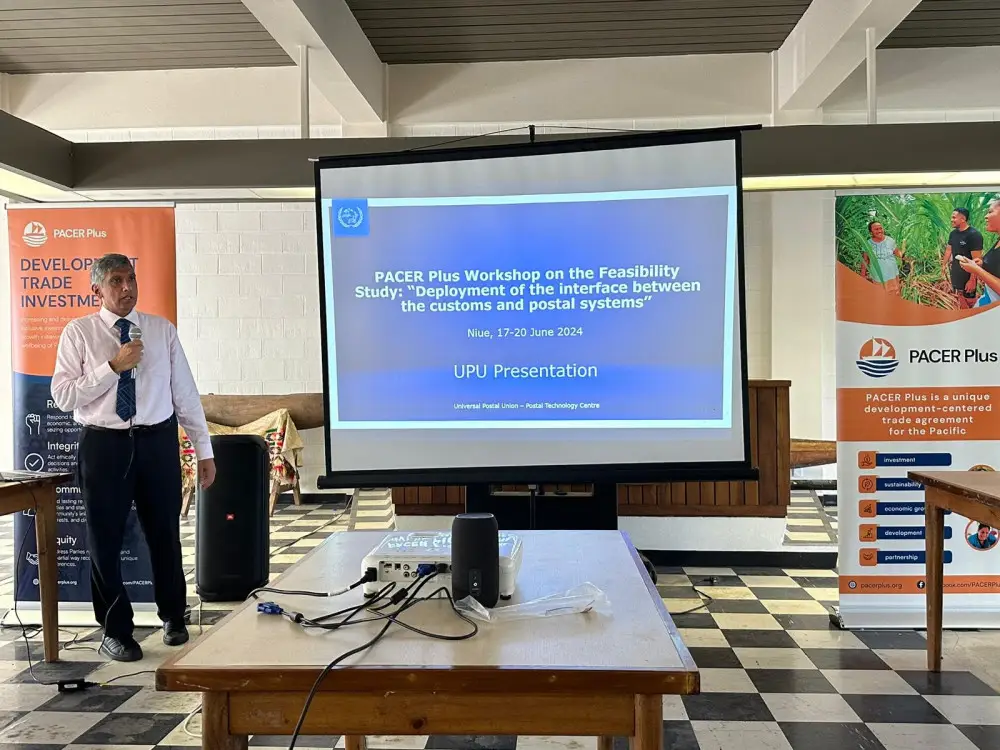
ALOFI, Niue – The Pacific Agreement on Closer Economic Relations (PACER) Plus continues to advance its objective of facilitating trade and investment among its 10 member countries. A critical component of this effort is the integration of customs and postal operation systems, a goal furthered by the recent feasibility study on the interface between the United Nations Trade and Development (UNCTAD) ASYCUDA World Systems for Customs and the Universal Postal Union (UPU) Customs Declaration System (CDS) for postal operation in Niue. Currently, the lack of integration between customs and postal systems causes delays and inefficiencies in the processing and clearance of international shipments. These challenges hinder the speed and cost-effectiveness of doing business online, affecting both businesses and consumers in the PACER Plus countries. Niue’s Minister for Finance and Infrastructure, Hon. Crossley Tatui (front row, fifth from right) with the Australian High Commissioner to Niue, H.E. Katy Stuart (front row, fourth from right), the New Zealand High Commissioner to Niue, H.E. Mark Gibb (front row, sixth from right), and Niue’s public and private stakeholders. The UPU CDS is a software application designed to enable the exchange of messages between customs and designated operators, allowing customs formalities to be completed before the arrival of postal items. By facilitating electronic data exchange between customs and postal authorities, the interface significantly streamlines the customs clearance process for e-commerce shipments. This advancement reduces the time and cost of doing business online for both businesses and consumers within PACER Plus member countries thus restoring confidence in the use of postal services for sending and receiving goods, especially e-commerce items. The UNCTAD ASYCUDA World system, widely used for customs management, and the UPU CDS, a standard for postal operations, are anticipated to yield significant benefits when integrated. These benefits include enhanced efficiency, transparency, and speed of cross-border trade in the region. Hon. Crossley Tatui, Niue’s Minister for Finance and Infrastructure, expressed his support for the initiative: “The successful integration of customs and postal systems through the PACER Plus agreement marks a significant step forward in facilitating trade and investment in our region. This initiative not only streamlines processes but also enhances transparency and efficiency, ultimately benefiting our businesses and consumers. We are excited to see the positive impact this will have on Niue.” Mr. Roy Lagolago, Head of the PACER Plus Implementation Unit, highlighted the pioneering nature of this initiative: “The rollout of this interface across the Pacific will make our region the first in the world to adopt such a harmonised system. This achievement is testament to the commitment of PACER Plus to leveraging technology to drive economic growth and improve trade facilitation for all PACER Plus members.” -ENDS- More articles like this one