
Overcoming Barriers: PB Agrifood is making small changes for a big difference

After just two months in Australia, Jimmy from Solomon Islands earned a reputation as one of PB Agrifood’s most productive and enthusiastic workers. While Jimmy has a hearing impairment, with no ability to hear in one ear and only partial hearing in the other, this has not been a barrier to his employment. With the help and support of his employer and colleagues, Jimmy is thriving in his role as a production hand at the Toowoomba-based business, which specialises in trading soybeans, mungbeans, sunflowers, birdseeds, protein meal and planting seed. Jimmy (right) is thriving in his role as a production hand at PB Agrifood. Next to Jimmy is company director, Catherine. Originally from Solomon Islands, Jimmy is part of the Pacific Australia Labour Mobility (PALM) scheme, which connects workers from the Pacific islands and Timor-Leste with eligible employers in Australia. He joined PB Agrifood in March 2023 and said he is grateful for the way his colleagues and employer have shaped his experience so far. “I’m really enjoying my new job. My friends help me with explanations, and they help me understand,” Jimmy said. PB Agrifood Director Catherine Brodie said the company had made some ‘reasonable adjustments’ in the workplace, to ensure Jimmy can perform all his tasks safely. “We just adjusted some of our procedures and communications with Jimmy to explain what tasks he had to do in his role. If he doesn’t quite understand us, we use sign language or write on paper,” she said. For PB Agrifood making some simple changes has paid off for everyone involved. “He has picked up the role so quickly and has gone 110% above and beyond. Jimmy is always a happy man, he is always smiling. He is one of the best baggers here, and the guys really appreciate having him on their team,” Catherine said. Although Catherine and her team have fulfilled their obligation to make reasonable adjustments for Jimmy, they wanted to take their support a step further. Jimmy has known he has a hearing impairment since he was young but doesn’t have access to hearing aids in Solomon Islands. “My parents knew I had a hearing problem and took me to the hospital but in my country, I couldn’t get hearing aids. They just checked and said, ‘you have a hearing problem’. Then I accepted it and moved on with my life,” he said. Having a hearing aid will impact Jimmy’s life long after he returns home from the PALM scheme. Moving to Australia meant that Jimmy would finally be able to access this technology–but it would cost AU$2,500, the equivalent of around six months’ savings. To improve the quality of his hearing sooner, PB Agrifood and Labour Solutions Australia, worked together with health insurance provider nib to cover the cost of Jimmy’s hearing aids. Within a few months, he was fitted with the small but life-changing devices. “When I hear my voice, the sound is different–it’s better,” said Jimmy, just after his fitting. “Now I will be able to talk easily with my workmates,” he added. But it’s not just about the workplace. Having a hearing aid will impact Jimmy’s life long after he returns home from the PALM scheme. “And my daughter–I’ll talk to her on the weekend. I will tell her that I have new hearing. I’ll tell her that my life has changed,” he said. More articles like this one
Collectively building the resilience of Pacific labour mobility

The Pacific labour mobility landscape has evolved considerably since the inception of the New Zealand Recognised Seasonal Employer (RSE) scheme and the Pacific Australia Labour Mobility Programme (originally the Seasonal Worker Programme and Pacific Labour Scheme). The onset of COVID-19, economic recessions, natural disasters and changing government policies have contributed to this evolution, warranting a relook at Pacific labour mobility settings to ensure resilience and sustainability. The 2024 Pacific Labour Mobility Annual Meeting (PLMAM) seeks to launch this discussion under the theme of “Collectively Building Resilience”. The PACER Plus Implementation Unit (PPIU) sat down with one of the leading experts on Pacific labour mobility, Emeritus Professor Richard Bedford, to get his insights on this theme and what we can envisage from the discussions at PLMAM. Emeritus Professor Richard Bedford. At the core of any considerations on the sustainability and resilience of Pacific labour mobility are the Pacific workers who supply labour and the New Zealand and Australian employers who demand their labour. Workers’ families and households should also not be discounted as they play a critical role in shaping the behavior and decision making of Pacific workers even when they are away from home. In this regard, the continued success of Pacific labour mobility really stems from ensuring that the costs to the workers and employers do not outweigh the benefits. Professor Bedford pointed out that the issue of costs versus benefits was the subject of a lot of discussion at the recent annual RSE Conference in New Zealand. “Several changes to a number of provisions relating to minimum payments to workers were announced at the Conference and while these have provided some welcome relief to employers they attracted sharp criticism from representatives of Pacific Governments who were in attendance,” noted Professor Bedford. The details of the changes can be found here and here, but one of the key concerns the Pacific representatives had was the absence of any consultation with them about the proposed changes in advance of their announcement and very rapid implementation, which was four days after the conference. Sudden changes in policy either in the labour sending or the labour receiving countries can create major challenges to key stakeholders in temporary migration schemes like the RSE and PALM. Consultation is clearly at the heart of PLMAM’s theme of “Collectively Building Resilience”. Sudden changes in policy either in the labour sending or the labour receiving countries can create major challenges to key stakeholders in temporary migration schemes like the RSE and PALM. As Vanuatu’s High Commissioner to New Zealand, His Excellency Mr. Jimmy Nipo, stressed in a thought-provoking keynote address entitled Sustainable bilateral relations: Vanuatu and the balancing act, “To ensure that our bilateral relations are sustained, the mutual benefits must be balanced out. The act of balance must be mutual. Open conversations must be done regularly.” PLMAM provides very valuable opportunities for “open conversations” about how we deal with ensuring balance in the distribution of costs and benefits from temporary labour migration policies. The impacts of climate change on economies and societies in the region must also be part of these conversations, not only because changing weather conditions are affecting workers’ hours of work and earnings, but also to determine how labour mobility can be used to build the resilience of their communities at home. Stakeholders at the PLMAM 2023 in Port Vila, Vanuatu. Professor Bedford emphasised that the importance of PLMAM lies in its ability to “provide a forum where a wide range of labour mobility stakeholders feel that they can share their views.” “There is real potential for a good relationship between countries in terms of temporary schemes that can enable people to earn money to help support their communities. The question is how do we maximise opportunities in these schemes to support that aspect of resilience in Pacific countries?” said Professor Bedford. Addressing these issues and building the resilience of Pacific labour mobility requires changes to policy settings in both labour receiving and labour sending countries. PLMAM provides a valuable platform for discussions to inform policy formulation in both labour sending and labour receiving countries particularly as it brings together workers, employers, governments of labour sending and labour receiving countries, unions, academics, private sector, civil society, and regional organisations. Professor Bedford emphasised that the importance of PLMAM lies in its ability to “provide a forum where a wide range of labour mobility stakeholders feel that they can share their views.” PLMAM also provides a platform for these views to be translated to action through an Outcomes Document which provides agreed actions to be implemented by various Pacific labour mobility stakeholders including the PACER Plus Implementation Unit. PLMAM provides very valuable opportunities for “open conversations” about how we deal with ensuring balance in the distribution of costs and benefits from temporary labour migration policies. The impacts of climate change on economies and societies in the region must also be part of these conversations, not only because changing weather conditions are affecting workers’ hours of work and earnings, but also to determine how labour mobility can be used to build the resilience of their communities at home. More articles like this one
Vanuatu’s Cacao Revolution
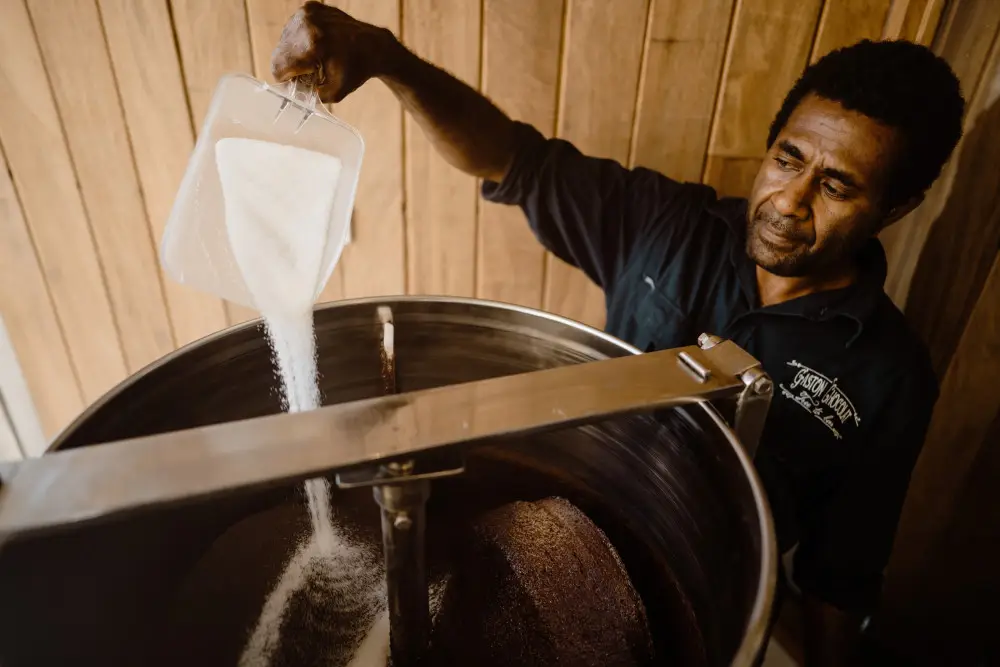
What started as a passion project to highlight Vanuatu’s rich cacao heritage has transformed into a thriving business for Gaston Chocolat exporting award-winning chocolate to Australia and New Zealand. But behind the success of Gaston Chocolat is a story of hard work, dedication, and the support provided by PACER Plus. Founded by Olivier Gaston, Gaston Chocolat was born from a simple idea: to produce world-class chocolate locally in Vanuatu while showcasing the country as a premium origin for fine cacao. But turning that vision into reality came with its challenges, especially when it came to meeting international food safety standards—a necessary step to export to larger markets. That’s where PACER Plus stepped in. In 2023, Gaston Chocolat exported 17 tonnes of dried cacao. This year, they’re on track to export 60 tonnes—almost a fourfold increase. In collaboration with the Vanuatu Chamber of Commerce and Industry and the Australia Vanuatu Governance for Growth program, PACER Plus engaged local consulting firm Quality Solutions to help Gaston Chocolat develop food safety systems. The goal was to achieve Hazard Analysis and Critical Control Point (HACCP) certification—a globally recognised standard that would open the doors to international trade. For Olivier Gaston and his team, the certification was a game-changer. “The HACCP certification shows that our operation is up to international standards,” says Mr. Gaston. “This way, people can trust the product. Because our chocolate can now travel to Australia and New Zealand, we can sell the cacao on a much larger scale to chocolate makers.” And the results speak for themselves. In 2023, Gaston Chocolat exported 17 tonnes of dried cacao. This year, they’re on track to export 60 tonnes—almost a fourfold increase. “That’s almost fifteen percent of the national market, and we’re quite proud of that achievement,” Mr. Gaston adds. But Gaston Chocolat’s impact goes beyond just business success. The company has built a network of 367 Ni-Vanuatu farmers, training them over the last decade to grow and harvest high-quality cacao. In 2024 alone, the farmers have been harvesting for a total of 57 days. And the rewards have been significant. Gaston Chocolat has built a network of 367 Ni-Vanuatu farmers, training them over the last decade to grow and harvest high-quality cacao. “Our farmers now earn the equivalent of twice the minimum wage by working just one day a week,” says Mr. Gaston. “Because we create jobs in the islands that pay more than the jobs in Vanuatu’s capital, Port Vila, we are fighting the urban drift. We’ve proven that rural jobs can pay better than city jobs.” Gaston is driven by more than just profits. “We are always conscious about looking after our staff well, respecting the culture, and considering our environmental impact,” he explains. “I want to run Gaston Chocolat sustainably, and I want everyone in the supply chain to benefit from the business and improve their standard of living.” More articles like this one
From Cacao Beans to Fruity Bars

Cathliro Commodities, a women-led, locally owned cocoa producer and exporter in Solomon Islands, has taken a significant step forward in its operations with the recent handover of a food dehydrator machine. The equipment, officially delivered in September 2024 and funded by the PACER Plus Development and Economic Cooperation (DEC) Work Programme, is set to enhance the company’s ability to produce value-added cocoa products and diversify into dried fruits. This support marks a turning point for the small business, which has become a beacon of hope for local farmers and a rising player in the international cocoa market. Diana Yates (far left), Cathliro Commodities founder, with Collin Beck (second from left), Permanent Secretary of Solomon Islands’ Ministry of Foreign Affairs and External Trade at the dehydrator handover along with Natalia Patternot (third from left), Director of Department of External Trade and Tristein Zutu, PACER Plus National Coordinator Solomon Islands. Cathliro Commodities was founded by Ms. Diana Yates, a determined entrepreneur with a vision to elevate Solomon Islands’ cocoa industry. Her 99-hectare cocoa farm, based in Guadalcanal, has been instrumental in connecting local farmers from nearby provinces, including Isabel and Makira, to international markets. The company purchases cocoa beans from over 200 local growers, transforming these raw materials into high-quality cocoa products for export. But the company’s ambition doesn’t stop there—Cathliro is diversifying its product line to include dried fruits like pineapple, banana, and pawpaw, a move that the new dehydrator will help realise. Speaking at the handover ceremony, Permanent Secretary of the Ministry of Foreign Affairs and External Trade (MFAET), Mr. Collin Beck, emphasised the significance of empowering local producers like Cathliro Commodities. The PACER Plus-funded food dehydrator machine is set to enhance Cathliro’s ability to produce value-added cocoa products and diversify into dried fruits. “Cathliro’s progress demonstrates the potential of Solomon Islands’ agricultural sector, not only to enhance food security but also to build wealth from within. By empowering local farmers, Cathliro is helping them integrate meaningfully into the formal economy,” said Mr. Beck. “We encourage everyone to support local producers—whether by drinking cocoa tea, using cocoa powder in your baking, or purchasing our new fruit-infused cocoa bars.” The new dehydrator, Mr. Beck explained, will enable Cathliro to sustain and expand its production of high-value cocoa products, providing a boost to both domestic markets and international exports. The equipment is also expected to enhance the company’s capacity to process fruits, tapping into a growing niche market for dried tropical fruits and cocoa-based products in boutique overseas markets. For Ms. Diana Yates, the founder of Cathliro Commodities, the new equipment is a game-changer. “This support from PACER Plus is a big win for us. We’ve been working tirelessly to grow our business and help local farmers, but this dehydrator opens up a new world of opportunities,” she said. “Now, we can diversify our products and ensure sustainability in our operations, whatever the weather. We’re able to expand our drying techniques and process a larger volume of both cocoa and fruit, which is crucial for entering new markets.” The dehydrator will enable Cathliro to boost the production of cocoa paste, cocoa nibs, cocoa powder, cocoa tea, fruity chocolate bars, and a range of dried fruit products. These innovations are part of the company’s broader effort to move from raw material exports to high-value, finished goods that meet international standards. PACER Plus’s support extended beyond equipment, including valuable capacity-building initiatives for Cathliro’s staff. Ms. Yates shared that staff members received both online and hands-on training, some of which took place in Australia. The Cathliro team after the completion of the PACER Plus-funded five-day chocolate training program with South Pacific Cacao trainer (center). “Our team has grown so much thanks to the training provided by PACER Plus. It’s been transformative,” she said. “The capacity-building workshops helped our staff develop new products like our fruity cocoa bars, and we’re even working on launching nutty bars soon. This progress wouldn’t have been possible without PACER Plus’s support.” Looking ahead, Cathliro is set to improve the quality of its offerings and scale its operations to meet international export requirements. With the help of PACER Plus, Cathliro Commodities is not only elevating Solomon Islands’ cocoa industry but also providing a blueprint for local businesses to grow, innovate, and thrive in regional and global markets. More articles like this one
Golden Success: How PACER Plus Helped Niue Honey Thrive

Niue Honey, recently named Best International Honey at the United Kingdom’s 85th National Honey Show—dubbed the Oscars of world honey—is not just any honey. It’s certified organic, unpasteurised, and boasts a complex palate of caramel and malt. But behind its success lies a story of resilience, innovation, and international collaboration that goes beyond taste. At the core of Niue Honey’s triumph is its unique origin: Niue is home to the world’s last known significant population of Italian honeybees, completely free from diseases and parasites that plague bee colonies elsewhere. These bees, Apis mellifera ligustica, are responsible for most global pollination, and their isolation on Niue has preserved their purity, making them a key asset in global efforts to safeguard bee populations. Niue Honey was recently named Best International Honey at the United Kingdom’s National Honey Show. However, it wasn’t always smooth sailing. Like many businesses across the Pacific, Niue Honey Company faced significant challenges during the COVID-19 pandemic. One of their biggest hurdles was securing their signature honey bottles, which had to be imported from China. With global supply chains disrupted, the company was at a standstill. “We asked ourselves, ‘How can we present a world-class innovative product in a world-class innovative way?’ recalled Richard Duncan of Niue Honey Company. “Our unique bottles set us apart, but when the supply from China stopped due to the lockdown, we were left scrambling for solutions. That’s when PACER Plus stepped in.” PACER Plus provided timely assistance. Through its DEC Work Programme, PACER Plus helped Niue Honey secure the designs and models necessary to produce their bottles closer to home. This collaboration not only salvaged the company’s ability to package their honey but also helped them establish a new bottle manufacturer in New Zealand. “PACER Plus really came through for us. They helped us get our bottles made in time, allowing Niue Honey to re-engage with the market. Now we have a New Zealand-based manufacturer producing our bottles, which has been a game-changer,” said Duncan. With their packaging challenges resolved, Niue Honey quickly regained momentum in the gourmet honey market. In New Zealand, their product was already well-established, but 2024 saw their expansion into Australia, where Niue Honey is now available at Whole Foods Australia (link here). Niue Honey also has plans to enter the United Kingdom by early 2025. “We’re working through the final paperwork to access the UK market,” Duncan shared. “When we do, this will be the first time an agricultural product from Niue reaches the UK. It’s exciting, as our honey tells a story—not just about our bees but about Niue and the wider Pacific.” Niue Honey is much more than a luxury product; it represents a significant contribution to agriculture and food security. Beyond honey production, the company also exports pure, healthy queen bees to help repopulate bee colonies worldwide. “Our bees are liquid gold,” Duncan said proudly. “We have the opportunity to breed and export queens to other Pacific islands, supporting food security and agricultural productivity across the region.” Award-winning New Zealand chef Peter Gordon has partnered with the Niue Honey Company, using it in a number of his dishes. This sense of purpose extends beyond Niue. As Duncan explained, the company envisions creating livelihood opportunities across the Pacific by reintroducing beekeeping on other islands. “Rebooting beekeeping as a livelihood generator, but more importantly, as a way to increase agricultural productivity—that’s a game-changer for agriculture in the region.” Award-winning New Zealand chef Peter Gordon, a champion of Niue Honey, stumbled upon the company’s product during a visit to the island. Known as the “godfather of fusion cuisine,” Chef Gordon has since used Niue Honey in various dishes and partnered with the company to help protect Niue’s unique bees through the Pacific Bee Sanctuary initiative. With PACER Plus’s support, Niue Honey is more than just a success story; it’s a testament to the power of regional cooperation and resilience. As Duncan put it, “The success of Niue Honey is not just about us—it’s about the Pacific, our bees, and the future of agriculture in the region.” More articles like this one
Empowering Women Entrepreneurs

Vanuatu’s Lapita Café’s Journey to HACCP Certification A widely respected community leader, Votausi Mackenzie-Reur wears many hats. One she dons proudly is that of founder of Lapita Café, an innovative and fast-growing food manufacturing and catering company in Port Vila, Vanuatu. Lapita Café is breaking barriers and reshaping the culinary landscape in Vanuatu. This International Women’s Day, Lapita Café stands as a testament of advancing women’s economic empowerment in the Pacific. Lapita Café, the pioneering gluten-free cassava flour producer in Vanuatu, has achieved a milestone by obtaining the Hazard Analysis and Critical Control Point (HACCP) certification. The journey, however, was no walk in the park. Battling the aftermath of cyclones that hampered construction and overcoming numerous challenges, Lapita Café emerged triumphant. https://youtu.be/Bo9IX3T72oU Watch Votausi Mackenzie-Reur’s interview as she talks about Lapita Cafe and why the HACCP certification was crucial for her business. Ms. Mackenzie-Reur’s commitment to excellence led Lapita Café to become the first gluten-free cassava flour producer in Vanuatu with HACCP certification, setting a high standard for others to follow. The certification ensures the highest food safety standards, making Lapita Café’s products not only delicious but also safe for consumers. “Lapita Cafe’s journey to be able to obtain its HACCP certification started in 2021, so it’s been a long time. But we were thankful to PACER Plus because they came in and were able to fund our HACCP certification towards the end of 2023. We’re immensely grateful to PACER Plus for supporting us in this,” said Ms. Mackenzie-Reur. The success story didn’t unfold in isolation. The Pacific Agreement on Closer Economic Relations (PACER) Plus, in collaboration with the Vanuatu Chamber of Commerce and Industry (VCCI) and the Australia Vanuatu Governance for Growth (GfG) program, played a pivotal role by engaging Vanuatu consulting firm Quality Solutions to develop food safety systems and coordinate a third-party audit in late 2023, a process that added an extra layer of credibility to Lapita Café’s operations. PACER Plus’s support, facilitated through VCCI and Quality Solutions, extends beyond Lapita Café. Four local manufacturers in Vanuatu are currently benefiting from ongoing initiatives to obtain similar international certifications, enhancing Vanuatu’s export advantage. PACER Plus recognises the important role women play in economic development and our capacity building programs to support women entrepreneurs like Ms. Votausi Mackenzie-Reur of Lapita Cafe in Vanuatu. The PACER Plus Implementation Unit (PPIU) recognises the important role women play in economic development and our capacity building programs. Supporting women entrepreneurs like Ms. Mackenzie-Reur is a testament to this. Gender is mainstreamed across PPIU’s operational and governance functions and across PPIU’s work programme. Lapita Café stands tall, not just as a business success but as a beacon of empowerment for women entrepreneurs. Ms. Mackenzie-Reur’s resilience and her company’s achievements underscore the importance of investing in women to accelerate progress and foster economic growth in the Pacific. -END- More articles like this one
From Ocean Depths to International Tables
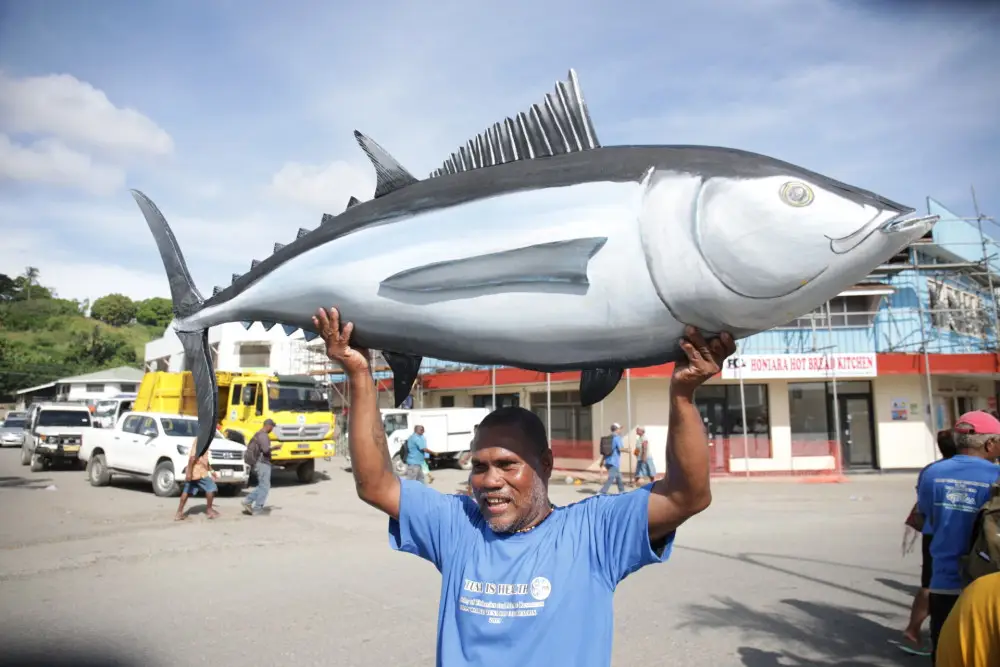
SolTuna’s Journey of Triumph with PACER Plus HONIARA, Solomon Islands – For years, the Solomon Islands’ pristine waters have cradled SolTuna, a leading tuna company, in their cerulean embrace. Amidst the ebb and flow of the tides, SolTuna battled daunting challenges, determined to deliver their prized tuna to the plates of Australians and New Zealanders. Their odyssey took a historic turn in 2020, when the Solomon Islands ratified the Pacific Agreement on Closer Economic Relations Plus or PACER Plus, a unique development-centered trade agreement that transformed SolTuna’s struggles into triumphs. Fish unloading at the wharf in Noro, Solomon Islands. (Photo: SIBC) “Before PACER Plus, SolTuna faced significant hurdles in exporting our tuna to Australia and New Zealand. Burdened by import duties, we found it hard to compete in these markets,” recalled Mr. Mark Gibble, SolTuna’s Business Development Manager. Despite these barriers, SolTuna’s spirit remained unyielding. Their commitment to quality and sustainability buoyed them through turbulent waters. With the ratification of PACER Plus, their efforts were not in vain. The agreement ushered in a new era, one where import duties were but a memory, paving the way for tariff-free exports. “PACER Plus has been a game-changer. It ensures we no longer pay import duties, revitalising our exports to Australia and New Zealand,” beamed Mr. Gribble. In the wake of tariff liberation, SolTuna’s exports soared. The aroma of freshly caught Solomon Islands tuna began gracing kitchens across Australia and New Zealand. But the impact transcended the realms of the market; it seeped into the heart of the Solomon Islands. With increased demand, SolTuna blossomed, sowing seeds of economic prosperity and job creation for the Pacific Island country. SolTuna’s surge in exports to Australia and New Zealand did more than boost the company’s bottom line. It became a beacon of hope for the people of the Solomon Islands, heralding a wave of employment opportunities. As SolTuna expanded its operations to meet the rising demand, a ripple effect of prosperity washed over the local communities. The increased production at SolTuna meant more hands were needed to harvest, process, and package the prized tuna, creating a surge in employment opportunities for the people. “Our success is not just measured in tons of tuna exported; it’s measured in the lives we touch and the communities we uplift in Solomon Islands. The positive impact of SolTuna’s growth goes beyond economic numbers. It’s about people, their dreams, and the collective progress of the Solomon Islands,” shared Mr. Gribble. “The effects of PACER Plus are profound. It ensures sustainable growth for our industry. With rising demands, we’re adopting eco-friendly practices, safeguarding our marine resources for generations to come,” added Mr. Gribble. “The future is promising. PACER Plus has granted us a competitive edge. We envision expanding our operations, generating employment, and continuing to offer sustainable, high-quality tuna worldwide.” Through tariff-free exports, SolTuna not only propels the economy forward but also safeguards the rich marine ecosystem that sustains countless livelihoods in the Solomon Islands. In every can of tuna exported, there is a story of resilience, collaboration, and a brighter future for a nation and its people. -END- More articles like this one
Solomon Islands Successful Transition to HS 2022

PACER Plus Supports Solomon Islands Boosts Trade Confidence In June 2020, Solomon Islands took a significant step toward economic integration by ratifying the Pacific Agreement on Closer Economic Relations (PACER) Plus trade agreement. This decision would play a pivotal role in navigating a crucial challenge – the transition to the Harmonised System (HS) 2022. The Harmonised System, a standardised numerical method of classifying traded products, serves as a global economic language, facilitating customs procedures, and ensuring consistency in the assessment of duties and taxes. With the latest update effective from 1 January 2022, more than 200 countries and economies, including Solomon Islands, were faced with the task of aligning their systems with HS 2022 standards. Mr. Michael Ligo (left), PPIU Consultant, with Ms. Alice Saefo’oa, from the Solomon Islands Ministry of Finance and Treasury. Recognising the importance of compliance with the PACER Plus Trade in Goods component, Solomon Islands sought assistance from the PACER Plus Implementation Unit (PPIU). Mr. Michael Ligo, the PPIU consultant who was responsible for supporting Solomon Islands in their transition to the Harmonised System 2022, shared, “The transition to HS 2022 is not merely an administrative task; it’s a testament to the commitment of Pacific countries to adhere to international standards. PACER Plus has been instrumental in providing the necessary technical assistance to ensure a seamless integration for the Solomon Islands.” Commencing in September 2022, the collaborative effort between PPIU and Solomon Islands aimed to peer-review existing practices, ensuring they adhered to the rigorous international standards set by HS 2022. This process took shape over three months, concluding in December 2022, paving the way for a seamless integration of HS 2022 into Solomon Islands’ customs procedures. Ms. Alice Saefo’oa, from the Solomon Islands Ministry of Finance and Treasury, described the significance of this collaboration, “The compliance with HS 2022 international standards is not only a regulatory milestone but a critical assurance for investors and the private sector. It signifies to the world that Solomon Islands is dedicated to maintaining international trade standards, fostering confidence among stakeholders involved in importing and exporting goods.” On 1 July 2023, Solomon Islands officially went live with HS 2022. Marking a historic moment in their commitment to international trade standards. The compliance not only benefits the government in streamlining customs operations but also provides a crucial signal to the global community, indicating that Solomon Islands is open for business and committed to facilitating international trade. PACER Plus emphasises the use of HS 2022 for tracking goods data entering and leaving the Pacific, creating a unified approach that fosters transparency and efficiency in regional trade. The successful collaboration between PPIU and Solomon Islands showcases the power of partnerships in addressing challenges and unlocking new opportunities for economic growth. Pacific PACER Plus countries, including Cook Islands, Kiribati, Samoa, Tonga, and Tuvalu, are currently undergoing their national approval processes, with plans to implement HS 2022 starting January 2024, thanks to the support of PPIU partners such as the Oceania Customs Organisation, United Nations Conference on Trade and Development, the Australian Government Department of Foreign Affairs and Trade, and New Zealand Customs Service. As Solomon Islands looks forward, the successful transition to HS 2022 positions the nation as a reliable and compliant partner on the global stage, reinforcing investor confidence and contributing to the overall economic prosperity of the Pacific region. -END- More articles like this one
Enhancing the Positives and Mitigating the Negatives of Labour Mobility for Vanuatu

Vanuatu, like many other Pacific Island Countries, are confronted with the inherent development challenges of their smallness, remoteness from key markets, and vulnerability to natural disasters and climate change. These development constraints are coupled by a rapidly growing population the the local formal economy cannot absorb. A high number of school leavers are consequently left unemployed each year resulting in added social and economic pressures on the local economy and society. Labour mobility has provided a critical employment creation strategy to generate growth dividends for Vanuatu. These positive development impacts are the key drivers for Vanuatu’s participation in labour mobility and has propagated its status as the top labour sending country for both the Pacific Australia Labour Mobility (PALM) and New Zealand Recognised Seasonal Employer (RSE) schemes. According to the Vanuatu Commissioner for Labour, Ms. Murielle Meltenoven, Vanuatu now has over 10,000 PALM workers in Australia and over 6,000 in New Zealand. The economic benefits of labour mobility for Vanuatu are largely transferred through the remittances and skills acquired by workers. “We see benefits in skills development especially around employability skills. We’ve received a lot of positive feedback from businesses around the conduct of workers including in communication, specifically customer service around servicing, and their ability to speak English,” Commissioner Meltenoven elaborated. She also highlighted the positive impacts on community development particularly in the rural areas including in upholding peace and order as unemployment is reduced. “When you travel around the six provinces (in Vanuatu), you see the real positive impact within the remote and rural communities around the new buildings, new businesses, so many banana boats which improve transportation helping many people residing in little islands to access crucial services,” Meltenoven stated. However, when it comes to building resilience against natural disasters, labour mobility has delivered mixed effects. In one hand, families and communities have more cyclone-resistant housing, but on the other, villages have less able-bodied men for post-cyclone recovery and rebuild. “Now you only see old people and kids, who are the most vulnerable during a period of natural disaster and in the recovery stage. They (villages) don’t have strong people to help for the recovery and to rebuild the community and the homes so for them the recovery will be very slow,” Commissioner Meltenoven explained. The loss of skilled employable people is also impacting local private sector development. “The private sector is suffering because they’re losing their skilled workers, of which they have invested so much money, so much time to train up. For example, in the tourism and hospitality industry, I can see that the current services has dropped a lot, the quality is no longer there,” Meltenoven stated. At the home front, she highlighted that social problems such as broken homes and domestic violence are rampant. Commissioner Meltenoven believes that these negative impacts emphasise the importance of conducive policies and support programmes in both labour sending and labour receiving countries. She highlighted that the PACER Plus Implementation Unit (PPIU) has funded a review of their labour mobility policy which will govern their labour mobility programmes in Vanuatu. The World Bank is also conducting a study to assess the impacts on private sector and the ILO is assisting with regulatory reforms to address issues. Vanuatu is also engaged in discussions with Australia and New Zealand to reconsider visa conditions and the length of work contracts in an effort to address social issues at home. Vanuatu, as host country of the 2023 Pacific Labour Mobility Annual Meeting (PLMAM) is also looking to optimise the opportunity to dialogue with key stakeholders on issues and to determine practical solutions. The PLMAM provides an opportunity for labour receiving and labour sending countries as well as other relevant organisations to come together to determine collective solutions that can maximise the positive impacts of labour mobility in the region whilst mitigating the negatives. More articles like this one
Pacific Labour Mobility: A Pillar of Growth for Australian and New Zealand Industries

Labour mobility is activated by unmet labour demand by employers in labour receiving countries. Employers therefore play a critical role in the success of Pacific labour mobility. Kerry McCarthy, a Pacific Australia Labour Mobility (PALM) employer and Gary Jones of Mr. Apple, a leading New Zealand Recognised Seasonal Employer (RSE) employer, shared their perspectives. Kerry McCarthy and her family run a vegetable business on the Darling Downs, just under three hours west of Brisbane, Australia. They specialise in growing leafy greens and sell to both the Brisbane markets and big grocery chains in Australia. Mr. Apple is New Zealand’s largest integrated grower, packer, and exporter of apples. Both companies have relied on Pacific workers since the inception of the labour mobility schemes, 2007 for New Zealand and 2012 for Australia. Kerry began with two workers in 2012 and now recruits around 60 workers from Solomon Islands. Mr. Apple recruits up to 1,300 workers per season from across the Pacific. Mayor of Hastings District Council, To’asavili Sandra Hazlehurst (seated) who received a Samoan chiefly title from the Falealili District chiefs, along with Mr Apple staff and RSE workers from that district in May 2023. Despite the varying scale and nature of the two companies’ operations, labour shortages were equally a chronic constraint to the growth of their businesses. “We became involved in the Seasonal Worker Program due to necessity. At that time, we were an isolated farm and could not find reliable local labour to employ. We tried using labour hire companies from the Lockyer Valley but as we were on the end of the line in regard to location, we were always given last priority. If you hadn’t already heard, in regional Australia there is a major labour shortage,” said Kerry. Similarly in New Zealand, Gary explained, “In the 1990s in New Zealand, there was a lot of people that were in seasonal roles working for the freezing works, processing, fishing, fencing, and farming and there were lots of New Zealanders who were moving around and could do seasonal work. But our communities and our jobs are completely changed, and New Zealanders are now more focusing on permanent urban roles and have become less available.” For businesses like these, Pacific labour mobility schemes provide a critical labour solution to underpin growth. Kerry shared, “It (PALM) has given us the confidence to expand our business, knowing that we can plan ahead, as our workers are going to be there for us and are going to stay with us for the whole season.” For Mr. Apple, “RSE underpinned our ability to provide quality fruit to our consumer. It’s allowed us to provide far higher quality to our consumers and the market. It’s given New Zealand apples a brand of being the best apples in the world. And the Pacific people (workers) have been a pillar that’s made the whole industry successful.” But behind the business transactions lies another layer to the success of Pacific labour mobility – the robust partnership between employers and local Pacific communities. Gary elaborated on Mr. Apples’ partnerships in the Pacific stating that “we have a partnership with the governments and the peoples of the Pacific, which is very important to us. Those relations are quite critical and the opportunity for us to partner with the governments enables us to make sure that issues can be identified, and risks can be mitigated.” For smaller family businesses like Kerry’s, this partnership is very close to home. Since 2012, Kerry has mostly recruited from a remote rural village in the Solomon Islands which has no road access and no electricity. Through her recruitments, she and her family have built a close bond with the local community. “My family visits the village; to witness the changes firsthand is overwhelming. All of this positive change has come from our small business. It boggles the imagination as to what can be achieved on a broader scale,” Kerry stated. A few years ago, Kerry and her children’s local school in Australia organised a school trip to the village in Solomon Islands. About 20 Australian high school kids and teachers experienced village life and donated support to the local school. Kerry shared that the experience significantly impacted the kids, and some have gone on to university to study development with a focus on the development needs of the Pacific, all based on their experience in Solomon Islands. The strength of these partnerships has caused many employers to want to give back more. They see that their role extends beyond recruiting workers to being agents of change and development. Many employers, like Kerry, are interested in providing direct support to social services in Pacific countries. She stated that “I would keep lobbing the Australian Government and also personally try and get investment flowing into the Pacific, starting with the Solomons for early detection of preventable diseases for women, particularly breast cancer and uterine cancer, HPV vaccines. But it’s difficult to know where to go, who to trust so that you know the ‘boots are put on the ground’ in the right area. It would be good for employers who want to contribute, but don’t know how to do it to be guided towards reputable businesses that are already established on the ground in the Pacific.” Other employers, such as Mr. Apple, see the opportunity to support local private sectors to grow entrepreneurship and business development. Gary explained that many employers and communities in New Zealand are at the stage where they “would like to see how to partner communities where their workers have got some collective capital and who are saying where should we invest our money now. Can we create some commerce at scale that will help that whole community to deliver? A good example of this is Hastings District Council and Hawkes Bay Iwi Ngati Kahungunu signing a Sister District agreement with Falealili District in Samoa. Both these communities have benefited immensely from the RSE scheme. Now these communities are saying how can