
Golden Success: How PACER Plus Helped Niue Honey Thrive

Niue Honey, recently named Best International Honey at the United Kingdom’s 85th National Honey Show—dubbed the Oscars of world honey—is not just any honey. It’s certified organic, unpasteurised, and boasts a complex palate of caramel and malt. But behind its success lies a story of resilience, innovation, and international collaboration that goes beyond taste. At the core of Niue Honey’s triumph is its unique origin: Niue is home to the world’s last known significant population of Italian honeybees, completely free from diseases and parasites that plague bee colonies elsewhere. These bees, Apis mellifera ligustica, are responsible for most global pollination, and their isolation on Niue has preserved their purity, making them a key asset in global efforts to safeguard bee populations. Niue Honey was recently named Best International Honey at the United Kingdom’s National Honey Show. However, it wasn’t always smooth sailing. Like many businesses across the Pacific, Niue Honey Company faced significant challenges during the COVID-19 pandemic. One of their biggest hurdles was securing their signature honey bottles, which had to be imported from China. With global supply chains disrupted, the company was at a standstill. “We asked ourselves, ‘How can we present a world-class innovative product in a world-class innovative way?’ recalled Richard Duncan of Niue Honey Company. “Our unique bottles set us apart, but when the supply from China stopped due to the lockdown, we were left scrambling for solutions. That’s when PACER Plus stepped in.” PACER Plus provided timely assistance. Through its DEC Work Programme, PACER Plus helped Niue Honey secure the designs and models necessary to produce their bottles closer to home. This collaboration not only salvaged the company’s ability to package their honey but also helped them establish a new bottle manufacturer in New Zealand. “PACER Plus really came through for us. They helped us get our bottles made in time, allowing Niue Honey to re-engage with the market. Now we have a New Zealand-based manufacturer producing our bottles, which has been a game-changer,” said Duncan. With their packaging challenges resolved, Niue Honey quickly regained momentum in the gourmet honey market. In New Zealand, their product was already well-established, but 2024 saw their expansion into Australia, where Niue Honey is now available at Whole Foods Australia (link here). Niue Honey also has plans to enter the United Kingdom by early 2025. “We’re working through the final paperwork to access the UK market,” Duncan shared. “When we do, this will be the first time an agricultural product from Niue reaches the UK. It’s exciting, as our honey tells a story—not just about our bees but about Niue and the wider Pacific.” Niue Honey is much more than a luxury product; it represents a significant contribution to agriculture and food security. Beyond honey production, the company also exports pure, healthy queen bees to help repopulate bee colonies worldwide. “Our bees are liquid gold,” Duncan said proudly. “We have the opportunity to breed and export queens to other Pacific islands, supporting food security and agricultural productivity across the region.” Award-winning New Zealand chef Peter Gordon has partnered with the Niue Honey Company, using it in a number of his dishes. This sense of purpose extends beyond Niue. As Duncan explained, the company envisions creating livelihood opportunities across the Pacific by reintroducing beekeeping on other islands. “Rebooting beekeeping as a livelihood generator, but more importantly, as a way to increase agricultural productivity—that’s a game-changer for agriculture in the region.” Award-winning New Zealand chef Peter Gordon, a champion of Niue Honey, stumbled upon the company’s product during a visit to the island. Known as the “godfather of fusion cuisine,” Chef Gordon has since used Niue Honey in various dishes and partnered with the company to help protect Niue’s unique bees through the Pacific Bee Sanctuary initiative. With PACER Plus’s support, Niue Honey is more than just a success story; it’s a testament to the power of regional cooperation and resilience. As Duncan put it, “The success of Niue Honey is not just about us—it’s about the Pacific, our bees, and the future of agriculture in the region.” More articles like this one
Handover of dehydrator equipment for women-led business in Solomon Islands

Cathliro Commodities, a women-led and locally owned cocoa producer and exporter in Solomon Islands, was officially handed over a food dehydrator machine on Friday 13 September 2024. The new equipment, funded by the Pacific Agreement on Closer Economic Relations (PACER) Plus Work Programme, is set to enhance the company’s capacity to process and export value-added cocoa products and dried fruits, both domestically and internationally. Diana Yates (far left), Cathliro Commodities founder, with Collin Beck (second from left), Permanent Secretary of Solomon Islands’ Ministry of Foreign Affairs and External Trade at the dehydrator handover along with Natalia Patternot (third from left), Director of Department of External Trade and Tristein Zutu, PACER Plus National Coordinator Solomon Islands. Cathliro Commodities, founded by Ms. Diana Yates, has been at the forefront of cocoa farming in the country. The company operates on a 99.9-hectare cocoa farm and works closely with local farmers, purchasing cocoa beans for processing and export. Recently, Cathliro has diversified into value-added chocolate products and expanded its operations to include dried fruits such as pineapple, banana, pawpaw, and mango. Speaking at the equipment handover ceremony, Solomon Islands Ministry of Foreign Affairs and External Trade (MFAET) Permanent Secretary Mr. Collin Beck, highlighted the importance of supporting local producers like Cathliro Commodities. “Cathliro’s progress shows the potential of Solomon Islands’ agricultural sector, not only to enhance food security but also to build wealth from within, allowing out growers to integrate meaningfully within the formal economy. “So, we call on everyone to drink more locally produced cocoa disks, purchase more cocoa powder for your baking needs and support our local producers. The food dehydrator will enable Cathliro to maintain and further expand production levels of cocoa,” said Mr. Beck. Mr. Beck highlighted that MFAET recognises the important role of the private sector organisations such as Cathliro in contributing to cocoa development for Solomon Islands alongside its network of almost 200 farmers in Guadalcanal, Isabel, and Makira Provinces. Cathliro Commodities is a women-led and locally owned cocoa producer and exporter in Solomon Islands. He commends Cathliro Commodities for their success in forging connections with new foreign markets for Solomon Islands cacao and downstream processing of their products. He encouraged Solomon Islanders to drink more local cocoa as a substitute to foreign beverage to assist in promoting local businesses like Cathliro Commodities. Ms. Diana Yates, founder of Cathliro Commodities, expressed her excitement at the new opportunities the equipment brings. “This support from PACER Plus is a big win for us. We’ve been working hard to grow our business and help local farmers, but this equipment will allow us to diversity our products, especially for boutique markets overseas and to ensure sustainability in our operations, whatever the weather may be, expanding drying technique capabilities by a larger volume,” said Ms. Yates. The dehydrator machine will help the company increase the volume of processed cocoa products, including cocoa paste, cocoa nibs, cocoa powder, cocoa tea and fruity chocolate bars, in addition to dried fruits. The funding of the food dehydrator aligns with PACER Plus’s Development and Economic Cooperation Work Programme, which aims to promote regional integration and trade development of the parties, including promotion of the participation of women, youth, and marginalised groups in trade and economic activities. Mr. Roy Lagolago, Head of the PACER Plus Implementation Unit, highlighted the regional significance of supporting SMEs to strengthen trade. “PACER Plus exists to help businesses like Cathliro to overcome barriers to trade and access new markets. This equipment will enable them to improve the quality of their products and meet the necessary requirements for international export. By empowering businesses in Solomon Islands, PACER Plus also ensures that trade benefits extend across communities in the Pacific,” said Mr. Lagolago. -ENDS- More articles like this one
Trade Information Portal Streamlines Pacific Trade Processes

APIA, Samoa – The PACER Plus Regional Workshop on Trade Information Portals (TIPs) commenced on Tuesday 4 June in Apia, Samoa. This workshop aims to enhance the accessibility of trade-related information for PACER Plus countries to increase their regulatory transparency in trade and investment-related capacity to reach the standards set out in PACER Plus. A TIP is a one-stop website where countries can access information on trade import and export procedures, laws, and regulations, for engaging in international trade. This platform makes complex trade procedures understandable by displaying them step-by-step from start to finish, from a trader’s point of view. Government officials from PACER Plus parties – Cook Islands, Kiribati, Niue, Samoa, Solomon Islands, Tonga, Tuvalu, Vanuatu, and UNCTAD – were present at the Regional Workshop on Trade Information Portals in Apia, Samoa. The Pacific Agreement on Closer Economic Relations (PACER) Plus is a unique trade agreement designed to raise living standards, create jobs, and boost exports from Pacific Island countries. By lowering trade barriers, PACER Plus provides greater certainty for businesses operating in the Pacific region. Julian Fraga-Campos, Economic Affairs Officer at the UN Trade and Development (UNCTAD), is leading the training sessions. “The establishment of Trade Information Portals is crucial for increasing transparency, enhancing predictability and facilitating smoother trade processes within the PACER Plus framework,” said Mr. Fraga-Campos. Alipate Tavo (left), PACER Plus Implementation Unit’s Trade and Investment Adviser, speaks at the closing of the Regional Workshop on Trade Information Portals with Julian Fraga-Campos, Economic Affairs Officer at the UN Trade and Development (UNCTAD). Government officials from PACER Plus parties – Cook Islands, Kiribati, Niue, Samoa, Solomon Islands, Tonga, Tuvalu, and Vanuatu – were present at the workshop. The workshop focuses on the creation of capacity among government officials for the implementation, management and sustainability of TIPs, as well as in providing training on notifications send through Contact Points and awareness of its obligations to ensure that all PACER Plus countries are informed and able to comply with the agreement’s standards. Alipate Tavo, PACER Plus Implementation Unit’s (PPIU) Trade and Investment Adviser, emphasised the importance of cooperation among PACER Plus countries. “As part of the PACER Plus agreement, countries have an obligation to share trade information and policy amendments with other PACER Plus parties. This ensures a cohesive and transparent trading environment that benefits everyone involved.” Keity Tuiloma from Samoa’s Ministry of Commerce, Industry, and Labour (left) with Verleena Nooapii from the Cook Islands at the Regional Workshop on Trade Information Portals in Apia, Samoa. Mrs. Angoango Fakaua from Kiribati’s Ministry of Tourism, Commerce, Industry and Cooperatives highlighted the impact of the workshop on her country’s trade practices. “This training is important for Kiribati as it equips us with the tools needed to streamline our trade processes and align with regional standards. It is an important step towards improving our trade infrastructure.” Ms. Ann Warsal from Vanuatu’s Department of Customs and Inland Revenue shared similar sentiments. “The Trade Information Portal has simplified the complexities of international trade regulations for Vanuatu, making it easier for our businesses to navigate and comply with trade requirements.” Ms. Keity Tuiloma from Samoa’s Ministry of Commerce, Industry, and Labour added, “Having a centralised source of trade information not only promotes efficiency but also enhances our ability to engage in international trade more effectively. This workshop is an important opportunity for us to learn and implement best practices.” The four-day training concludes on Friday 7 June. -END- More articles like this one
PACER Plus Initiative Supports Samoa’s Agricultural Export Capacity

The Pacific Agreement on Closer Economic Relations (PACER) Plus Implementation Unit (PPIU) handed over 800 harvest bins to the Samoa Ministry of Agriculture and Fisheries today. The handover ceremony marks a pivotal moment in addressing a persistent challenge faced by Samoan farmers – the loss and damage of harvested commodities during transportation to processing and cleaning facilities. This issue has long hindered Samoa’s ability to fully capitalise on its agricultural potential in the global market. Hon. Laaulialemalietoa Leuatea Polataivao Fosi Schmidt (fourth from left), Samoa’s Minister of Agriculture and Fisheries, shakes hands with Mr. Roy Lagolago, Head of PPIU, and H.E. Will Robinson, Australian High Commissioner to Samoa, with Samoan exporters at the handover ceremony. Speaking during the handover, Hon. Laaulialemalietoa Leuatea Polataivao Fosi Schmidt, Samoa’s Minister of Agriculture and Fisheries (MAF), emphasised the significance of this initiative in empowering local farmers and enhancing Samoa’s export capacity. “By addressing the critical issue of postharvest loss and damage, we are empowering our farmers to maximise the export potential of our local produce. In doing so, we are not only protecting the livelihoods of our farmers but also tapping into new opportunities for export growth,” said Hon. Schmidt. “With the addition of the 800 harvest bins today, we now have a total of 980 bins at our disposal, thanks to the initial provision of 180 harvest bins by PACER Plus in August 2022. Additionally, the support provided by PACER Plus extends beyond harvesting bins, encompassing essential biosecurity equipment and IT resources to streamline operations,” added Hon. Schmidt. Mr. Roy Lagolago (left), Head of PPIU, shakes hands with Hon. Laaulialemalietoa Leuatea Polataivao Fosi Schmidt, Samoa’s Minister of Agriculture and Fisheries, during the handover ceremony. The investment from PACER Plus totals AUD130,000 or WST253,190. This demonstrates a dedicated effort to strengthen Samoa’s agricultural infrastructure and improve market access for Samoan produce. The PACER Plus Implementation Unit leads the implementation of the PACER Plus Development and Economic Cooperation Work Programme, jointly funded by the governments of Australia and New Zealand. H.E. Will Robinson, the Australian High Commissioner to Samoa, who was present at the handover, said: “Australia is proud to support initiatives like these that not only strengthen Samoa’s agricultural sector but also foster sustainable economic development.” The handover ceremony was held at MAF’s Atele Packhouse outside Apia, and attended by members of the diplomatic corps, Samoan exporters, and representatives from the agricultural community. -ENDS- More articles like this one
Empowering Women Entrepreneurs

Vanuatu’s Lapita Café’s Journey to HACCP Certification A widely respected community leader, Votausi Mackenzie-Reur wears many hats. One she dons proudly is that of founder of Lapita Café, an innovative and fast-growing food manufacturing and catering company in Port Vila, Vanuatu. Lapita Café is breaking barriers and reshaping the culinary landscape in Vanuatu. This International Women’s Day, Lapita Café stands as a testament of advancing women’s economic empowerment in the Pacific. Lapita Café, the pioneering gluten-free cassava flour producer in Vanuatu, has achieved a milestone by obtaining the Hazard Analysis and Critical Control Point (HACCP) certification. The journey, however, was no walk in the park. Battling the aftermath of cyclones that hampered construction and overcoming numerous challenges, Lapita Café emerged triumphant. https://youtu.be/Bo9IX3T72oU Watch Votausi Mackenzie-Reur’s interview as she talks about Lapita Cafe and why the HACCP certification was crucial for her business. Ms. Mackenzie-Reur’s commitment to excellence led Lapita Café to become the first gluten-free cassava flour producer in Vanuatu with HACCP certification, setting a high standard for others to follow. The certification ensures the highest food safety standards, making Lapita Café’s products not only delicious but also safe for consumers. “Lapita Cafe’s journey to be able to obtain its HACCP certification started in 2021, so it’s been a long time. But we were thankful to PACER Plus because they came in and were able to fund our HACCP certification towards the end of 2023. We’re immensely grateful to PACER Plus for supporting us in this,” said Ms. Mackenzie-Reur. The success story didn’t unfold in isolation. The Pacific Agreement on Closer Economic Relations (PACER) Plus, in collaboration with the Vanuatu Chamber of Commerce and Industry (VCCI) and the Australia Vanuatu Governance for Growth (GfG) program, played a pivotal role by engaging Vanuatu consulting firm Quality Solutions to develop food safety systems and coordinate a third-party audit in late 2023, a process that added an extra layer of credibility to Lapita Café’s operations. PACER Plus’s support, facilitated through VCCI and Quality Solutions, extends beyond Lapita Café. Four local manufacturers in Vanuatu are currently benefiting from ongoing initiatives to obtain similar international certifications, enhancing Vanuatu’s export advantage. PACER Plus recognises the important role women play in economic development and our capacity building programs to support women entrepreneurs like Ms. Votausi Mackenzie-Reur of Lapita Cafe in Vanuatu. The PACER Plus Implementation Unit (PPIU) recognises the important role women play in economic development and our capacity building programs. Supporting women entrepreneurs like Ms. Mackenzie-Reur is a testament to this. Gender is mainstreamed across PPIU’s operational and governance functions and across PPIU’s work programme. Lapita Café stands tall, not just as a business success but as a beacon of empowerment for women entrepreneurs. Ms. Mackenzie-Reur’s resilience and her company’s achievements underscore the importance of investing in women to accelerate progress and foster economic growth in the Pacific. -END- More articles like this one
From Ocean Depths to International Tables

SolTuna’s Journey of Triumph with PACER Plus HONIARA, Solomon Islands – For years, the Solomon Islands’ pristine waters have cradled SolTuna, a leading tuna company, in their cerulean embrace. Amidst the ebb and flow of the tides, SolTuna battled daunting challenges, determined to deliver their prized tuna to the plates of Australians and New Zealanders. Their odyssey took a historic turn in 2020, when the Solomon Islands ratified the Pacific Agreement on Closer Economic Relations Plus or PACER Plus, a unique development-centered trade agreement that transformed SolTuna’s struggles into triumphs. Fish unloading at the wharf in Noro, Solomon Islands. (Photo: SIBC) “Before PACER Plus, SolTuna faced significant hurdles in exporting our tuna to Australia and New Zealand. Burdened by import duties, we found it hard to compete in these markets,” recalled Mr. Mark Gibble, SolTuna’s Business Development Manager. Despite these barriers, SolTuna’s spirit remained unyielding. Their commitment to quality and sustainability buoyed them through turbulent waters. With the ratification of PACER Plus, their efforts were not in vain. The agreement ushered in a new era, one where import duties were but a memory, paving the way for tariff-free exports. “PACER Plus has been a game-changer. It ensures we no longer pay import duties, revitalising our exports to Australia and New Zealand,” beamed Mr. Gribble. In the wake of tariff liberation, SolTuna’s exports soared. The aroma of freshly caught Solomon Islands tuna began gracing kitchens across Australia and New Zealand. But the impact transcended the realms of the market; it seeped into the heart of the Solomon Islands. With increased demand, SolTuna blossomed, sowing seeds of economic prosperity and job creation for the Pacific Island country. SolTuna’s surge in exports to Australia and New Zealand did more than boost the company’s bottom line. It became a beacon of hope for the people of the Solomon Islands, heralding a wave of employment opportunities. As SolTuna expanded its operations to meet the rising demand, a ripple effect of prosperity washed over the local communities. The increased production at SolTuna meant more hands were needed to harvest, process, and package the prized tuna, creating a surge in employment opportunities for the people. “Our success is not just measured in tons of tuna exported; it’s measured in the lives we touch and the communities we uplift in Solomon Islands. The positive impact of SolTuna’s growth goes beyond economic numbers. It’s about people, their dreams, and the collective progress of the Solomon Islands,” shared Mr. Gribble. “The effects of PACER Plus are profound. It ensures sustainable growth for our industry. With rising demands, we’re adopting eco-friendly practices, safeguarding our marine resources for generations to come,” added Mr. Gribble. “The future is promising. PACER Plus has granted us a competitive edge. We envision expanding our operations, generating employment, and continuing to offer sustainable, high-quality tuna worldwide.” Through tariff-free exports, SolTuna not only propels the economy forward but also safeguards the rich marine ecosystem that sustains countless livelihoods in the Solomon Islands. In every can of tuna exported, there is a story of resilience, collaboration, and a brighter future for a nation and its people. -END- More articles like this one
PACER Plus Implementation Unit Advocates for International Standards at the ISO Annual Meeting

BRISBANE, Australia – Mr. Roy Lagolago, Head of the PACER Plus Implementation Unit (PPIU), was among the participants at the International Organisation for Standardisation (ISO) Annual Meeting, held from 18-22 September 2023 in Brisbane, Australia. The event, hosted by Standards Australia, brought together global experts and leaders to discuss collaboration, innovation, and sustainable solutions for addressing pressing global challenges. It also explored the role of International Standards in achieving the 2030 Global Agenda’s Sustainable Development Goals. Mr. Roy Lagolago makes a presentation at the ISO Annual Meeting in Brisbane, Australia. Mr. Lagolago’s presence at the ISO Annual Meeting was marked by a talanoa focused on how the Pacific Agreement on Closer Economic Relations Plus (PACER Plus) could support Pacific parties in becoming more actively engaged with ISO standards and understanding their significance. PACER Plus, a unique development-based trade agreement between Australia, New Zealand and eight Pacific countries, aims to foster economic growth, trade liberalisation, and sustainable development among its parties. Mr. Lagolago’s discussion with interested delegates from the Pacific explored how PACER Plus could contribute to their ambitions to play a more significant role in ISO’s standardisation efforts. “We believe that embracing international standards is key to achieving economic growth, sustainability, and prosperity in the Pacific,” said Mr. Lagolago. “PACER Plus is committed to helping our member nations better understand and engage with ISO standards to enhance the quality of products and services they offer while facilitating trade with the broader international community.” The Pacific delegation’s attendance at the ISO Annual Meeting was made possible through the support of Standards Australia and the United Kingdom’s Foreign, Commonwealth and Development Office. Their contributions enabled officials from the Pacific to participate actively in discussions and share their perspectives on standards development. The United Kingdom is also committing AU$5.8 million to bolster the adoption of standards within Commonwealth countries. This investment aims to dismantle trade barriers, foster economic resilience, diminish reliance on aid, and pave the way for Pacific countries and other Commonwealth members to seize new opportunities for international businesses. Regional officials discuss how PACER Plus can support Pacific countries in becoming more actively engaged with ISO standards and understanding their significance. Hon. Crossley Tatui, Niue’s Minister for Finance and Infrastructure and the current chair of the PACER Plus Ministers Meeting, emphasized the significance of PACER Plus at both national and regional levels, highlighting its potential to deliver tangible benefits to Pacific countries. Ms. Leata Alaimoana, Queensland Trade Commissioner for the Pacific, discussed the close ties between the Australian state of Queensland and the Pacific, underscoring the opportunities for greater engagement with PACER Plus. Dr. Ulrich Diekmann, Regional Quality Infrastructure Coordination with the Pacific Islands Forum Secretariat, provided valuable insights into the Pacific’s ongoing efforts to strengthen its quality infrastructure, aligning with international standards to improve competitiveness and trade capabilities. The ISO Annual Meeting provided a vital platform for fostering global partnerships and advancing the adoption of international standards. The participation of Mr. Lagolago in facilitating discussions on PACER Plus and its connection to ISO standards underscored the Agreement’s commitment to quality, sustainability, and international collaboration. -END- More articles like this one
PACER Plus Empowers Farmers in Solomon Islands’ Malaita Province
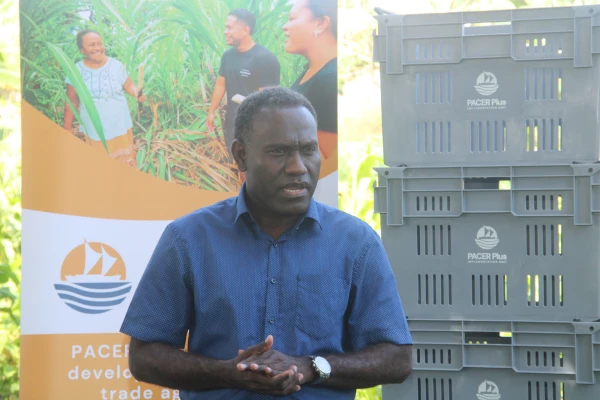
PACER Plus has assisted Goshen Enterprise Ltd with the provision of 500 harvest bins to assist the company in its efforts to support farmers on Malaita Province, Solomon Islands. The harvest bins were handed over by the Trade Commissioner in the Ministry of Foreign Affairs and External Trade (MFAET) Solomon Islands, Mr. Barrett Salato to Goshen Enterprise representative at the Ministry of Agriculture and Livestock Biosecurity area at Henderson, Solomon Islands yesterday (17 August 2023). MFAET Trade Commissioner Mr. Barrett Salato (left) handing over the harvest bins to Goshen’s Mr. Levite Maesimae (right) and witnessed by Ministry of Agriculture and Livestock Deputy Director of Biosecurity Solomon Islands, Mr. Crispus Fanai (center). The bins will be used to assist farmers in the post-harvest process where products will be harvested and transported to Goshen’s newly operated pack-house on Malaita for storage and eventual distribution to the domestic and international markets. Mr. Salato acknowledged the support from PACER Plus Implementation Unit (PPIU) in providing the bins that would go a long way in assisting Goshen and farmers on Malaita. He said Goshen has been working together with farmers on Malaita to encourage them to go into taro farming and increase productivity. He stressed that the bins are useful for harvest and transport to the processing facility. “I trust that Goshen will distribute the bins to their farmers and will be made useful for its intended purpose,” he added. Goshen Enterprises Limited was the beneficiary of a Taro Pack House on Malaita with funding support from the World Trade Organisation’s Enhanced Integrated Framework (EIF) Programme. Under EIF-Enhanced Capabilities of Agriculture Trade (ECAT) project in the Solomon Islands, emphasis was made on the development of taro products with focus on two provinces, Temotu and Malaita. Trade Commissioner Salato said that the Solomon Islands Government is keen to export taro to the international market soon. Trade Commissioner Salato said the Ministry of Foreign Affairs and External Trade would like to see that at some stage, Solomon Islands will be able to export taro to the international market, especially Australia and New Zealand with the Pacific diaspora. “I understand that the supply of taro is high at both markets and therefore this is where our target should be. With the close of the EIF-ECAT Project in June 2023, PACER Plus is coming on board to assist the Country with some of its programs. The delivery of these harvesting bins is a testimony of the support by PACER Plus,” he added. In receiving the harvesting bins, Goshen’s Levite Maesimae said farmers on Malaita have expressed concerns about the quality of their products when reaching the processing facility, hence the bins would greatly assist in the storage and handling of the products. He thanked PACER Plus for providing the bins to Goshen Enterprise. “It’s a delight to witness the tangible impact of PACER Plus in action, as it contributes to the growth and development of enterprises like Goshen on Malaita. These harvest bins serve as a testament to the collaborative efforts between PACER Plus and the Solomon Islands’ government as well as local businesses, uplifting farmers and enhancing the post-harvest processes. This initiative showcases the commitment to fostering agricultural prosperity and trade within Solomon Islands and the Pacific,” said Mr. Alipate Tavo, the PPIU Trade and Investment Adviser. -END- More articles like this one
PACER Plus Fumigation Training to Enhance Biosecurity Measures in Vanuatu

PORT VILA, Vanuatu – Pacific countries are facing multiple capacity constraints in the crucial areas of biosecurity requirements, treatments, and general Sanitary and Phytosanitary (SPS) Measures. Recognising the significance of addressing these challenges, the PACER Plus Implementation Unit (PPIU) has organised a comprehensive training program on fumigation treatment and accreditation scheme, aimed at strengthening the skills and knowledge of biosecurity and quarantine personnel in Vanuatu. Armstrong Sam, Director of Biosecurity Vanuatu, (fourth from left) flanked by representatives of Nordiko Quarantine Systems and biosecurity officials from Samoa, Solomon Islands, and Vanuatu. The four-day training which commences today will focus on providing participants with a better understanding of the application and handling of methyl bromide, a widely used fumigant known as ‘toxic gas’. By equipping the participants with the necessary expertise, this initiative aims to enhance compliance with Australian import requirements and improve overall biosecurity measures. The PPIU has collaborated closely with the Australian Department of Agriculture, Fisheries, and Forestry (DAFF) to ensure the alignment of training activities for the Australian component of this program. In this regard, Australian company Nordiko Quarantine Systems has been chosen as the key training provider due to their expertise and reputation as the main supplier of fumigation equipment to the Pacific. Mr. Armstrong Sam, Director of Biosecurity Vanuatu, expressed his support for this training program, stating, “There are multiple capacity constraints in the areas of biosecurity requirements, treatments, and general SPS Measures in Vanuatu. This activity will provide training to biosecurity and quarantine personnel, providing a better understanding for the application and safe handling of methyl bromide.” This training program represents a significant step forward in strengthening biosecurity measures and enhancing the capacity of Pacific National Plant Protection Organisations and stakeholders along the plant export pathway. By equipping biosecurity personnel with the necessary skills, knowledge, and tools, the program aims to bolster compliance with international standards, thereby safeguarding the agricultural industries and environments of Pacific countries. -END- More articles like this one
Exporting Samoan Taro to New Zealand

Empowering Farmers and Nurturing Communities In the heart of Samoa, where lush green fields stretch under the embrace of the Pacific sun, a remarkable story of resilience and opportunity unfolds. Meet Seuamuli Kome Robbie Lauano, a 48-year-old entrepreneur whose dedication and resourcefulness have brought the flavours of Samoan taro to the shores of New Zealand, thanks to the support of the Ministry of Agriculture and Fisheries (MAF) Samoa and the PACER Plus Implementation Unit. Mr. Lauano’s journey began with a simple but profound realisation. He saw the untapped potential of small farmers in Samoa who lacked the opportunity to export their produce. Determined to bridge this gap, Mr. Lauano reached out to the PACER Plus Implementation Unit, which utilised its networks to support Mr Lauano. With a vision of empowering local farmers, Mr. Lauano set out to purchase their taro, offering fair prices that sustained their families in numerous ways. By eliminating the middlemen and directly supporting the farmers, he not only ensured their financial stability but also fostered a sense of hope and optimism within the community. Iopu Ma’aolo (left), a farmer from Savai’i, smiles as he receives WS$1,080 in cash from Seuamuli Kome Robbie Lauano for the export of his taro. Through Mr. Lauano’s efforts, over 2,000 kilograms of Samoan taro made their way to New Zealand, crossing borders with zero tariffs under the PACER Plus agreement. The destination was Papakura Wholesale Meats Direct, a store in Auckland, New Zealand owned by Mr. Lauano and his business partner, Toomata Paul Stowers. The response from consumers were overwhelming, as word spread about the availability of fresh, high-quality Samoan taro. Throngs of eager customers travelled from Otara, Manurewa, and Mangere to savour the taste of these traditional delights. The aroma of boiled taro filled the air, as families gathered around tables adorned with the bounty from Samoa. The connection to their cultural heritage was rekindled, and the demand for Samoan taro soared. For Mr. Iopu Ma’aolo, a 35-year-old farmer from Savai’i, this newfound opportunity brought tangible improvements to his family’s life. With a beaming smile, he shared how he earned WS$1,080 (US$400) from the export of his taro. Comparing the current market prices, he expressed gratitude for the upfront payment and the increased value of his produce. The additional income would help secure a brighter future for his two children, offering them improved access to education and healthcare. Avea Vaoga (right), a farmer from Savai’i, receives WS$5,400 from Seuamuli Kome Robbie Lauano which he plans to invest in his farm. Similarly, Mr. Avea Vaoga, a 52-year-old farmer also from Savai’i, rejoiced at the fruits of his labour. When he received a cash payment of WS$5,400 (US$2,000) for his taro, his joy knew no bounds. As a community leader, Mr. Vaoga understood the significance of this opportunity not only for his family but also for the entire community. With his newfound earnings, he planned to invest in his farm, providing employment to young men in the village. The prospect of agricultural prosperity excited him, as he envisioned a future where opportunities for export continued to uplift local farmers. Beyond the financial gains, the export of Samoan taro holds deeper significance. It symbolises a revival of cultural identity and pride, reminding Samoans living abroad of their roots. The aroma, taste, and texture of this traditional staple transport them back to cherished memories and traditions, strengthening the bonds that unite the Samoan diaspora. The success of Mr. Lauano’s venture highlights the importance of empowering local farmers and supporting agricultural growth in Pacific countries. Samoa’s MAF and the PACER Plus Implementation Unit’s role in supporting this journey serves as a testament to the transformative power of collaboration and opportunity. As the sun sets over the expansive taro fields of Samoa, Mr. Lauano continues to work tirelessly, bridging the gap between farmers and distant markets. His story is a testament to the resilience and determination of Pacific communities and a beacon of hope for farmers who dare to dream of a brighter future. With each kilogram of Samoan taro exported, a legacy of empowerment, sustainability, and cultural preservation is written, one that echoes through generations to come. -END- More articles like this one