
PACER Plus partners with SPTO to promote sustainable tourism in the region
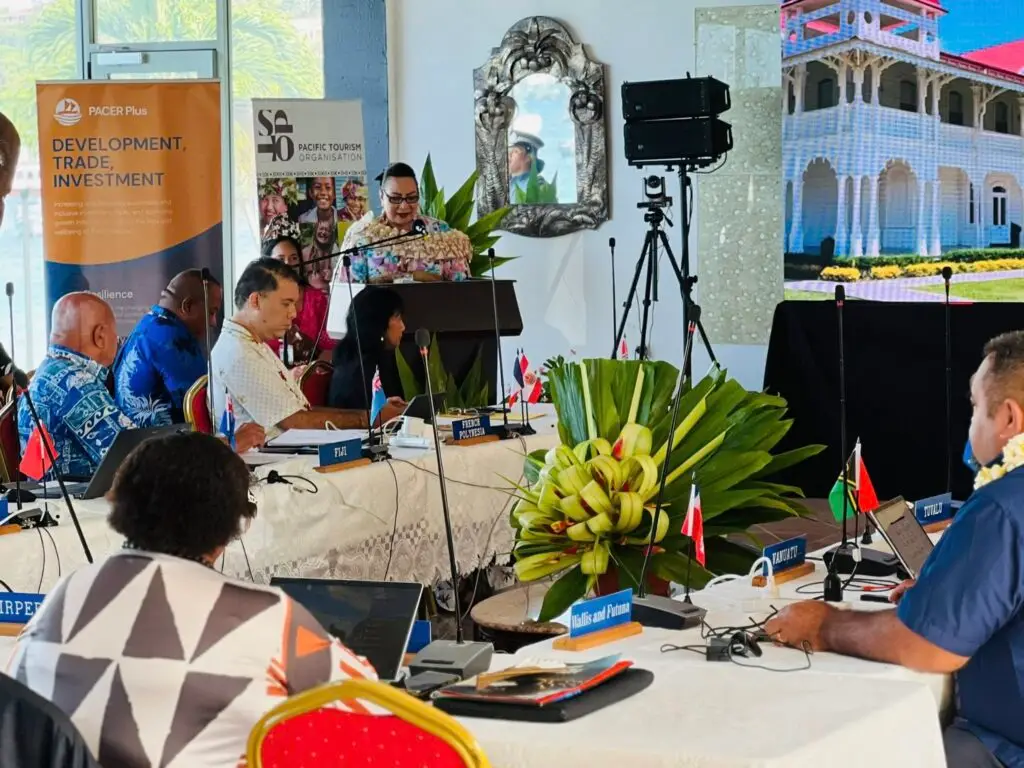
VAVA’U, Tonga – The PACER Plus Implementation Unit (PPIU) provided funding support and took part in the Pacific Tourism Organisation (SPTO) meetings held in Vava’u, Kingdom of Tonga, from 20 to 22 October 2025. The three-day gathering included the SPTO Board of Directors Meeting, the Council of Tourism Ministers Meeting, and the Pacific Sustainable Tourism Leadership Summit 2025. The Princess Royal, Her Royal Highness Princess Salote Mafile’o Pilolevu Tuita, Patron of Tourism Tonga, delivers her opening address. (Photo: SPTO) The meetings brought together Pacific tourism ministers, national tourism directors, private sector representatives, and youth delegates to discuss how the region can build a tourism industry that is sustainable, inclusive, and resilient. As the Pacific’s only trade agreement that covers trade in services, PACER Plus played a vital role in highlighting the importance of trade in services, investment, and labour mobility — all critical enablers of a thriving and sustainable tourism sector. “Trade in services is the backbone of the global economy, accounting for over 60 percent of global GDP, and it’s growing faster than trade in goods. In the Pacific, tourism has become an engine of growth. But to stay strong, it needs to be sustainable, inclusive, and resilient. Creating the right policy environment is key, and this is where PACER Plus can make a real difference.” Dr. Alisi Kautoke Holani, Labour Mobility Specialist and Trade in Services and Investment Lead at the PPIU Dr. Alisi Holani (far right) of the PPIU with Pacific tourism stakeholders at the SPTO meetings in Vava’u, Tonga. (Photo: SPTO) SPTO Chief Executive Officer Mr Christopher Cocker shared this view, thanking PACER Plus for their support and saying that tourism must continue to deliver more than economic benefits. “For tourism to fulfil its full potential across our Blue Pacific Continent, it must not only generate economic value but also reinforce our cultures, empower our youth, and protect our natural environment,” he said. “The policy landscape must support this — enabling connectivity, investment, community-led enterprises, and digital access. Together with partners like PACER Plus, we can ensure that tourism remains an engine of inclusive growth, resilience, and regional identity.” Through its participation, PACER Plus strengthened collaboration with SPTO, Pacific governments, and other development partners to enhance the enabling environment for trade in services and investment. The partnership also supports efforts to improve policy coherence and promote sustainable and digital transformation initiatives across the region. This engagement will contribute to the implementation of the Pacific 2030 Sustainable Tourism Policy Framework and advance shared regional goals under PACER Plus, helping to build stronger, more connected, and more resilient Pacific economies through sustainable tourism and inclusive trade. -ENDS- More articles like this one
Fair Beginnings, Strong Returns

Rethinking Reintegration in Pacific Labour Mobility The theme of this year’s Pacific Labour Mobility Annual Meeting (PLMAM), “Sustainable Reintegration Begins with Fair and Effective Recruitment”, raises an important question: what does reintegration really mean in the context of Pacific labour mobility? For seasonal workers in New Zealand’s Recognised Seasonal Employer (RSE) scheme, time away is usually six months, after which they must return home for at least five months before being eligible to recruit for the RSE again. Unlike the nine-month PALM visas in Australia, there is no pathway to a longer-term stay from the RSE visa. On the face of it, reintegration after six months is not likely to be a major issue for recruits who work for one or two seasons. Only 40 percent of the 56,500 recruits for the RSE since 2007 have returned for three or more seasons. The picture changes when absences accumulate year after year. For workers who leave, say, Samoa for six months annually, repeating this cycle for four or more years, the rhythm of absence and return inevitably creates family and community challenges. Adjusting to life at home after repeated long absences is not always seamless. Social stresses, family expectations, and even rumours about workers’ behaviour abroad can complicate the return. This is why the theme of this year’s meeting is so timely. Reintegration is not just about coming home once — it’s about managing the long-term impacts of seasonal as well as long-term cyclical migration. Fair and effective recruitment lies at the heart of sustainable reintegration, writes the author. Shifts in Labour Mobility The broader labour mobility landscape in the Pacific has been transformed dramatically over the past decade, particularly in Australia. Until the introduction of the Seasonal Worker Programme, the forerunner to today’s Pacific Australia Labour Mobility (PALM) scheme, Pacific people had no dedicated migration channel into Australia’s workforce. The PALM scheme, particularly its long-term stream, marks a significant policy shift. For the first time in over a century, Australia opened long-term, low-skilled and semi-skilled labour pathways for Pacific people. This is a profound change, one that mirrors New Zealand’s longer history of engagement. Australia has invested heavily in staffing, administration, and support to make the scheme work both onshore and in labour sending countries. Meanwhile, New Zealand’s RSE scheme continues to provide opportunities, though demand there has plateaued. In recent years, the cap on RSE numbers has not been reached. Rising costs for employers, from compliance and accommodation to pastoral care, have curbed demand. In Samoa, for example, New Zealand approved employers now pay a fee per Samoan worker, and Samoan workers themselves also face new costs. These financial pressures, on both sides, are shaping the trajectory of recruitment. Recruitment, Fairness, and Reintegration Fair and effective recruitment lies at the heart of sustainable reintegration. Labour sending countries often want to distribute opportunities equitably, ensuring that benefits are shared across communities. Yet recruitment often happens through established relationships between employers and experienced workers, who are then asked to recommend new candidates. While this system provides continuity, it risks limiting access for those outside the existing networks. Governments in countries such as Samoa, Tonga, and Vanuatu have sought to centralise recruitment through Labour Sending Units (LSUs). But balancing fairness with employers’ preferences remains a challenge. The critical question is how to ensure that workers participate with a clear plan for their earnings — whether that is education costs, housing, or small business ventures — rather than treating seasonal work as a lifestyle of permanent dependency on cash incomes earned through temporary labour migration overseas. In New Zealand, where workers must always return home, reintegration planning is essential to ensure maximum benefit from short-term circular migration. In Australia, where transitions from short-term to long-term PALM visas are possible, the pressures on families can be even greater, with absences stretching to years. The challenges of reintegration are different in this context. For some families, temporary work overseas has become a primary livelihood strategy, even passed down across generations. While remittances are vital, this kind of dependency risks undermining local livelihoods in the long term. Reintegration is not just about coming home once, writes the author. It’s about managing the long-term impacts of seasonal as well as long-term cyclical migration. The Changing Labour Market Looking ahead, sustainability will depend on recognising shifts in global and regional labour markets. Technological change, particularly automation, is already reshaping demand. In New Zealand, for instance, pack houses that once employed large numbers of women are becoming increasingly automated, reducing the need for seasonal labour. Technology will continue to disrupt traditional roles. Consumer expectations are also evolving. Major international buyers of agricultural products are scrutinising labour conditions more closely. Questions around ethical recruitment, modern slavery, and cost-sharing practices are now influencing whether large companies choose to buy Australian and New Zealand produce. For example, comparisons are being made between the costs borne by temporary migrant workers in New Zealand versus those recruited in the United States, where employers are often required to cover transport fully. These perceptions matter and will affect the long-term viability of Pacific labour mobility schemes. Priorities for Sustainability To keep Pacific labour mobility successful and sustainable, several priorities stand out. First, costs must remain manageable for both approved employers and workers. If participation becomes too expensive, demand will decline, and workers will struggle to send meaningful remittances home. Second, labour sending countries must play a proactive role in promoting fair recruitment and supporting reintegration. This means ensuring access is broad-based and encouraging workers to have long-term financial plans for their earnings. It also means discouraging the pattern where families become wholly reliant on seasonal migration, which may not be viable in the long run. Finally, stakeholders must keep pace with global shifts, from technology to consumer standards. Ethical recruitment, decent working conditions, and transparency will increasingly be non-negotiable in global supply chains. If PALM and RSE schemes can stay ahead of these expectations, they will remain attractive to both approved employers and consumers. Returning
Regional Workshop Advances Implementation of Tariff Commitments under PACER Plus
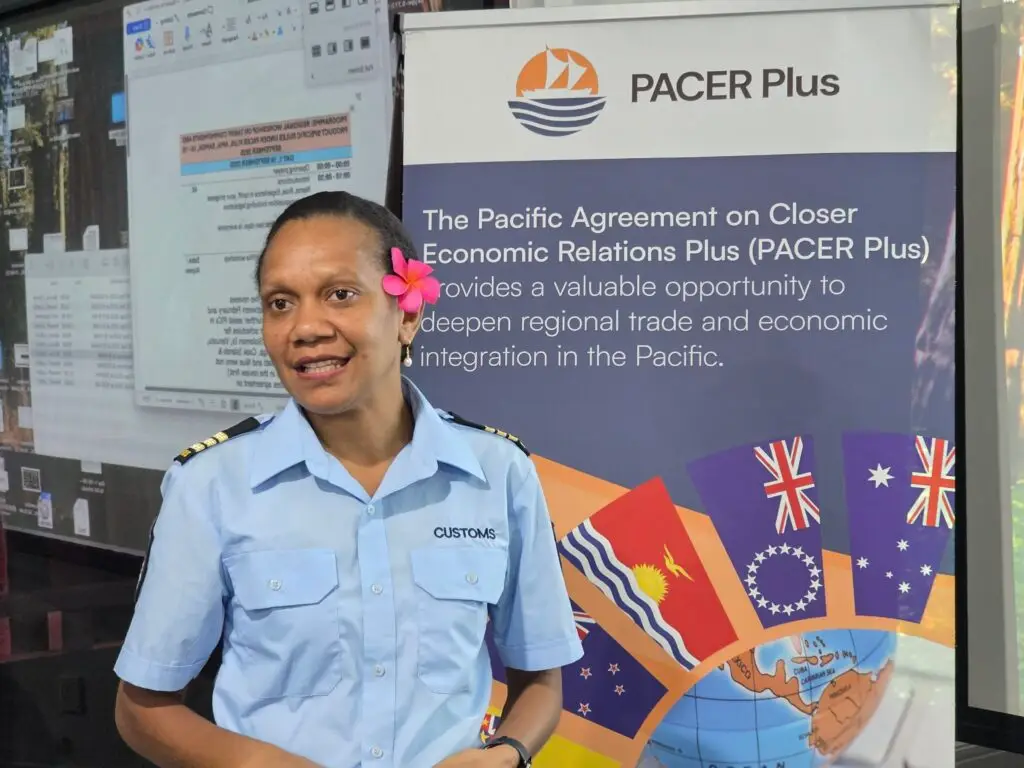
APIA, Samoa – Customs officials from eight Pacific Island countries have concluded a three-day Regional Workshop on Transposition of Tariff Commitments and Product-Specific Rules (PSRs) under the Pacific Agreement on Closer Economic Relations Plus (PACER Plus). The workshop, held in Apia, Samoa, from 16-18 September 2025, brought together officials from the Cook Islands, Kiribati, Niue, Samoa, Solomon Islands, Tonga, Tuvalu, and Vanuatu. The workshop was designed to help countries align their PACER Plus tariff schedules and product-specific rules with the latest version of the Harmonised System (HS), an internationally standardised system of names and numbers used to classify traded products. Periodic updates to the HS ensure that trade rules keep pace with new products and changing technologies. Ms. Sisilia Asel Lui from Vanuatu Customs and Inland Revenue makes a point at the workshop. For Pacific Island member countries of the PACER Plus, updating tariff commitments and PSRs is essential to ensure that goods can move freely and fairly across borders of the PACER Plus Parties. Without these updates, countries risk inconsistencies in how goods are treated, which could create unnecessary trade barriers, confusion for traders, and revenue collection implications. “HS 2022 introduced over 350 sets of amendments to product classifications, and Pacific Island countries need to update their commitments to reflect these changes. This workshop provided a valuable opportunity to work through technical issues together, harmonise approaches, and set realistic timelines for implementation.” Mr. Saba Vallipuram, Tariff and Rules of Origin Expert, who has been assisting PACER Plus countries with this process since early 2025 As of January 2025, countries were at different stages of updating their tariff commitments. Samoa, Tonga, and Vanuatu have made progress with draft HS2022 transposed schedules, while others such as Kiribati and Tuvalu were slightly behind. The Solomon Islands recently finalised its updated tariff schedule. This week’s workshop has helped remaining countries, particularly Kiribati and Tuvalu, to take concrete steps towards completing their schedules. It also equips countries with the knowledge and tools for the next transposition to HS2028. Mrs. Annette Kotela Ibe, Team Leader Technical at the Ministry of Finance’s Customs and Excise Division in Solomon Islands, noted the importance of the workshop for building regional consistency: “For Pacific Island countries like ours, aligning tariff commitments and product-specific rules is not just about compliance. It’s also about creating a level playing field for our businesses. This workshop gave us clarity and practical tools to move forward. It also reassures traders that PACER Plus countries are committed to facilitating trade in a fair and transparent way.” Customs officials from eight Pacific Island countries at the three-day Regional Workshop on Transposition of Tariff Commitments and Product-Specific Rules under PACER Plus in Apia, Samoa. At the close of the workshop, participants agreed on next steps to finalise their updated tariff commitment schedules, address pending comments from earlier technical reviews, and complete the necessary legislative processes to adopt the new transposed HS2022 schedules. For Pacific exporters and importers, this work means simpler, clearer, and more predictable trade rules. For governments, it strengthens the foundation for economic growth by ensuring that PACER Plus continues to deliver on its promise of expanding regional trade and investment. -ENDS- More articles like this one
PACER Plus Implementation Unit attends FTOM and FTMM in Fiji
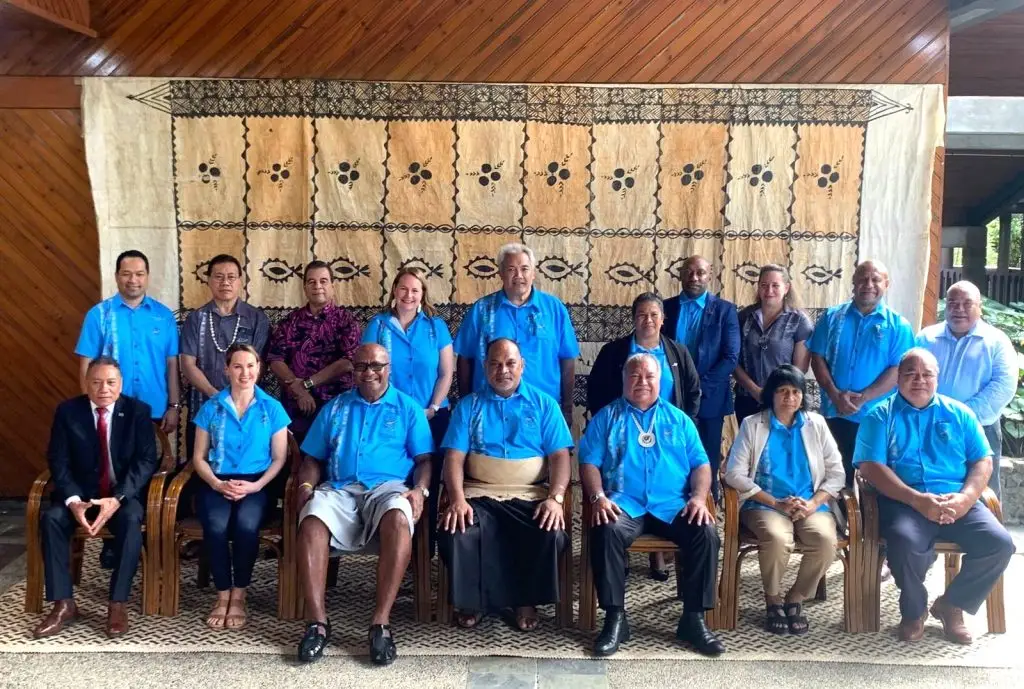
SUVA, Fiji – The Forum Trade Officials and Trade Ministers meeting was convened on 16-18 July 2025 in Suva, Fiji, to deliberate on key trade issues affecting the Pacific region, against the backdrop of an increasingly complex global and regional economic landscape. Ministers reaffirmed their commitment to a rules-based multilateral trading system to enhance the region’s gains from international trade. The geographic development challenges of the region further underscored the critical need for increased regional integration through regional initiatives that reflect the region’s collective needs and priorities. These initiatives include the 2050 Strategy for the Blue Pacific Continent, the Pacific Roadmap for Economic Development (PRED), and the Pacific Aid for Trade Strategy. The draft Pacific Regional Labour Mobility Principles were also considered as directed by Forum Leaders in 2023. Hon. Peter Shanel Agovaka, Minister of Foreign Affairs and External Trade of Solomon Islands, delivered a statement on behalf of the PACER Plus Parties, highlighting progress and milestones since the Agreement entered into force in 2020. In his remarks, Hon. Agovaka highlighted the integral role of PACER Plus in promoting regional economic integration through reducing barriers to trade and optimising opportunities in trade in goods, services trade, investment and labour mobility. While reaffirming PACER Plus Parties commitment to a predictable rules-based trading system, Hon. Agovaka also encouraged other Forum members’ accession to PACER Plus to increase the impact of the Treaty and to further deepen regional economic integration in the Pacific. During the meeting, Ministers approved observer status for the PACER Plus Implementation Unit (PPIU) to the Forum Trade Ministers Meeting. The PPIU welcomed this decision as a strategic step towards enhancing regional trade coordination and participation in key regional trade discussions. The PPIU also used the opportunity during the meeting to meet with regional partners to discuss alignment of priorities and collaboration opportunities. -ENDS- More articles like this one
PACER Plus Parties Unite to Tackle Social Impacts of Labour Mobility
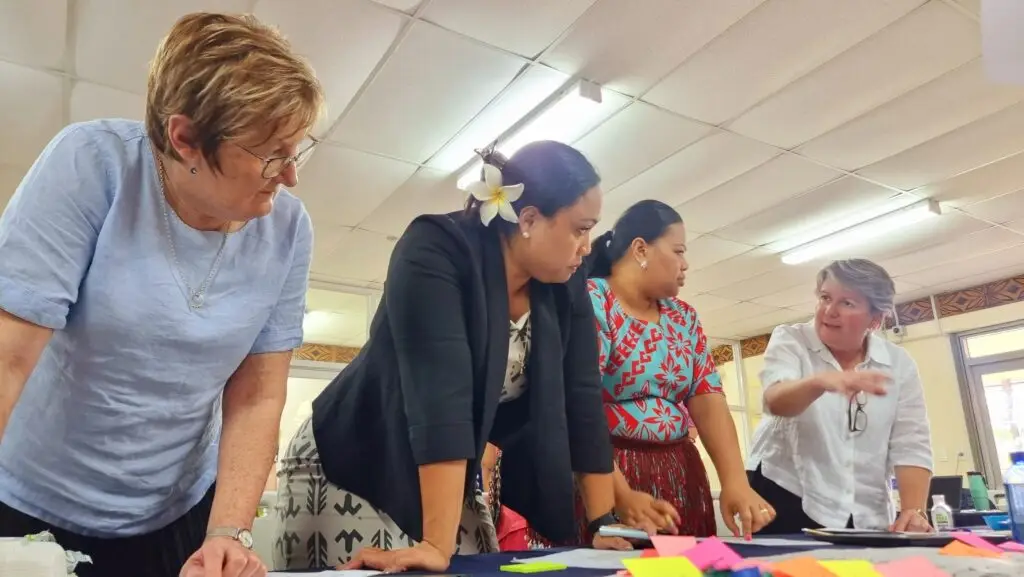
The Regional Workshop on Addressing the Social Impacts of Labour Mobility in the PACER Plus Arrangement on Labour Mobility (ALM) opened today and brings together officials from the 11 PACER Plus ALM signatory countries. APIA, Samoa – PACER Plus Parties have come together in Apia, Samoa, this week to talk about how to better understand and address the negative social impacts of Pacific labour mobility. The four-day Regional Workshop on Addressing the Social Impacts of Labour Mobility in the PACER Plus Arrangement on Labour Mobility (ALM) opened today and brings together officials from the 11 PACER Plus ALM signatory countries: Australia, Cook Islands, Kiribati, Nauru, New Zealand, Niue, Samoa, Solomon Islands, Tonga, Tuvalu, and Vanuatu. The workshop is being hosted by the PACER Plus Implementation Unit (PPIU), which serves as the Labour Mobility Secretariat. The PACER Plus Arrangement on Labour Mobility is a regional cooperation framework that sits alongside the PACER Plus trade agreement. It aims to strengthen labour mobility cooperation by promoting good practices and enabling policies that can increase the mutual development benefits of labour mobility for labour receiving and labour sending countries. Kevin Meplu, Senior Trade Officer at the Solomon Islands Department of External Trade. A review of the ALM in 2023 highlighted the need to do more to protect workers and ensure that labour mobility delivers positive outcomes not just for individuals, but for their families and home communities. The review found that some workers face difficulties such as poor accommodation, high migration costs, and limited understanding of their rights and responsibilities while abroad. It also found that employers and systems in Australia and New Zealand are sometimes not well-equipped to understand or respond to the specific needs and cultural values of Pacific workers. This week’s workshop aims to help define what “social impacts” of labour mobility really mean in a Pacific context — and how best to manage them. Participants will also provide feedback on two important draft tools: the Pacific Guidelines on Sustainable Reintegration, and the General Guidance on Pacific Labour Mobility Worker Recruitment. Both tools are being developed by the PPIU to support better worker preparation, safer migration experiences, and effective labour migration reintegration that enhances the economic and social benefits of labour mobility. “This workshop is a step forward in making sure that the next stage of our work under the ALM responds directly to the needs and priorities of Pacific countries, workers, and communities. We are bringing together the lived realities of our people and using those insights to shape better regional cooperation. Our focus is to complement, not duplicate, what countries and stakeholders are already doing. This is about building something stronger together.” Dr. Alisi Holani, Trade in Services & Investment Adviser and Labour Mobility Specialist at the PPIU Discussions at the workshop will also help shape the new social impacts component of the ALM work programme. The goal is to ensure that it reflects the priorities of Pacific countries and provides practical tools to support ethical recruitment, decent work, and sustainable reintegration of workers. The workshop will conclude on Thursday, 26 June 2025. More articles like this one
Pacific Workers’ Superannuation Talanoa Address Critical Issues

APIA, Samoa – The Pacific Australia Labour Mobility (PALM) scheme and the Recognised Seasonal Employers (RSE) program have been instrumental in promoting economic development and fostering regional cooperation among Pacific participant countries. However, an ongoing challenge faced by workers under these schemes relates to superannuation arrangements and the accessibility of funds upon return to their countries of origin. To address this pressing issue and find a comprehensive regional solution, the PACER Plus Implementation Unit initiated the first Regional Virtual Talanoa on Superannuation Arrangements in the RSE and PALM Schemes today. The virtual talanoa was an outcome of the 2022 Pacific Labour Mobility Annual Meeting (PLMAM) and aimed to increase understanding of existing superannuation arrangements, the issues involved and establish a regional way forward to addressing these issues. Key stakeholders from Australia and New Zealand, Pacific PACER Plus Parties and Signatories to the PACER Plus Arrangement on Labour Mobility, as well as representatives from PALM and RSE labour sending countries which are not Parties to the PACER Plus met virtually today for the first Regional Virtual Talanoa on Superannuation Arrangements in the RSE and PALM Schemes. In establishing this regional way forward on superannuation, it was important to ensure an inclusive talanoa that can mutually deliver benefits to both labour sending and labour receiving countries. The talanoa therefore brought together key stakeholders from Australia and New Zealand, Pacific PACER Plus Parties and Signatories to the PACER Plus Arrangement on Labour Mobility, as well as representatives from PALM and RSE labour sending countries which are not Parties to the PACER Plus. Superannuation arrangements differ between Australia and New Zealand, with Australian laws mandating Approved Employers to contribute 11 percent of gross earnings to workers’ superannuation funds. On the other hand, New Zealand’s RSE program does not require employers to make superannuation contributions, but the New Zealand government and RSE employers have looked into other superannuation arrangements for workers. Superannuation funds are additional financial flows that can support Pacific households and communities as well as contribute to economic development in Pacific labour sending countries. These monies are claimed upon workers’ return to their countries and exists as a form of savings additional to their wages. Improving the process for claiming these funds and exploring opportunities for transfers to national provident funds would increase the benefits to workers and their communities. During today’s virtual gathering, participants engaged in candid discussions, exchanged perspectives, and jointly explored feasible solutions that ensure equitable and efficient superannuation arrangements for all workers under the RSE and PALM schemes. The PACER Plus Implementation Unit is committed to fostering stronger cooperation among labour receiving and sending countries and is confident that it is through increased cooperation that arrangements such as for superannuation can be improved so as to increase benefits to the Pacific. -ENDS- More articles like this one
Pacific Trade Strengthened as Regional Workshop Concludes in Honiara

HONIARA, Solomon Islands – The Pacific Regional Advanced Trade in Goods Workshop, a key event aimed at strengthening trade capacity in the Pacific, has successfully concluded. The three-day workshop, held from 12-14 August 2024, was organised through a partnership between the Australian Government’s Department of Foreign Affairs and Trade (DFAT) and the PACER Plus Implementation Unit (PPIU). Mr. Colin Beck (center), Permanent Secretary of Solomon Islands’ Ministry of Foreign Affairs and External Trade with Mr. Andrew Schloeffel (fifth from left), Australian Deputy High Commissioner to Solomon Islands and government officials from PACER Plus Pacific countries at the Pacific Regional Advanced Trade in Goods Workshop in Honiara, Solomon Islands. The workshop brought together government officials from Cook Islands, Kiribati, Niue, Samoa, Solomon Islands, Tonga, Tuvalu, and Vanuatu to deepen their understanding of the rules-based trading system, World Trade Organisation (WTO) structures, agreements, and the challenges and opportunities they present to Pacific Island countries. Participants also explored the intricacies of multilateral and regional trade agreements, including PACER Plus, and their applications within the region. Mr. Colin Beck, Permanent Secretary of Solomon Islands’ Ministry of Foreign Affairs and External Trade. In his opening remarks, Mr. Colin Beck, Permanent Secretary of Solomon Islands’ Ministry of Foreign Affairs and External Trade, highlighted the significance of PACER Plus supporting customs automation and improvement in biosecurity measures in Solomon Islands. “PACER Plus has the potential to be a powerful tool for our development, but it is crucial that its initiatives are country-initiated and country-led. There is an opportunity to strengthen delivery of PACER Plus initiatives, ensuring it truly meets the needs of our people.” Colin Beck, Permanent Secretary of Solomon Islands’ Ministry of Foreign Affairs and External Trade Mr. Andrew Schloeffel, Australian Deputy High Commissioner to Solomon Islands, highlighted the role of trade in driving sustainable growth and economic resilience in the Pacific. “Under PACER Plus, all member countries have tariff and quota-free access to Australia. This covers all product lines — 100 percent of products exported enter Australia duty-free. And this commitment will continue irrespective of the development status of each member country.” Andrew Schloeffel, Australian Deputy High Commissioner to Solomon Islands The workshop is part of broader capacity-building efforts for the Pacific region, designed to enhance the understanding of trade-related issues and support the economic integration of Pacific Island countries into the global trading system. -ENDS- More articles like this one
PACER Plus Joint Committee Charts Strategic Path Forward for Pacific Trade and Development

HONIARA, Solomon Islands – The Eighth Meeting of the PACER Plus Joint Committee concluded on Tuesday 6 May 2025 in Honiara, Solomon Islands, bringing together senior government officials from Australia, Cook Islands, Kiribati, New Zealand, Niue, Samoa, Solomon Islands, Tonga, Tuvalu, and Vanuatu. Chaired by Ambassador Collin Beck, Permanent Secretary of the Solomon Islands Ministry of Foreign Affairs and External Trade, the two-day meeting provided a crucial platform for Parties to review progress, reimagine the future of PACER Plus, and strengthen regional economic integration. Senior government officials from the ten PACER Plus Parties gathered in Honiara, Solomon Islands for the Eighth PACER Plus Joint Committee Meeting. Ambassador Beck underscored the significance of PACER Plus in navigating today’s uncertain global trade environment. “PACER Plus was envisioned as a pathway toward deepening economic integration across the Blue Pacific Continent by creating a predictable, rules-based trade environment and unlocking targeted development assistance through the PACER Plus Development and Economic Cooperation (DEC) Work Programme. This meeting was an opportunity to reflect on the past, reimagine the Agreement’s next phase, and ensure it delivers meaningful impact for our people.” Ambassador Collin Beck, Permanent Secretary of the Solomon Islands Ministry of Foreign Affairs and External Trade The DEC Work Programme, funded by Australia and New Zealand, is a cornerstone of PACER Plus implementation, designed to support Pacific Island countries in building trade capacity, strengthening industries, and overcoming barriers to economic growth. It provides targeted assistance in areas such as export development, trade facilitation, and skills training, ensuring that Pacific Parties can fully benefit from regional and global trade opportunities. Ms. Natalia Patternot, Director, Department of External Trade with the Ministry of Foreign Affairs and External Trade in Solomon Islands speaks at the PACER Plus Joint Committee Meeting. The meeting approved high-level strategic priorities for the next DEC Work Programme cycle (2025-2030) commencing the work towards confirming arrangements required for continuation of the DEC Work Programme beyond 2025. Discussions emphasised the need for a sharper focus on export development, value chain strengthening, reducing shipping and logistics costs, and targeted skills development. The meeting also highlighted the importance of private sector engagement, digital trade as a key economic driver, and the alignment of strategic priorities with measurable 2030 targets under the Monitoring, Evaluation, Learning and Adaptation (MELA) Framework. Parties reaffirmed PACER Plus as a vital mechanism for regional economic integration, in line with the 2050 Strategy for the Blue Pacific Continent. Expanding membership remains a key priority, with commitments to advocate for new members to join the Agreement. Mr. Alan Armistead, Director of International and Trade Affairs Division with the Ministry of Foreign Affairs and Immigration Cook Islands speaks at the PACER Plus Joint Committee Meeting. Australia and New Zealand provided updates on the current internal governance reviews required to confirm resourcing for the next DEC Work Programme (2025-2030). Ambassador Beck expressed gratitude on behalf of all Parties: “We deeply appreciate the ongoing commitment of Australia and New Zealand to PACER Plus, both through their current funding and their expressed support for the next phase. Their partnership is instrumental in ensuring Pacific nations can harness trade for sustainable development.” The Joint Committee reaffirmed Parties’ commitment to the rules-based multilateral trading system, with the World Trade Organisation at its core. A joint statement was adopted as follows: “We affirm our commitment to a transparent, non-discriminatory, and open rules-based multilateral trading system which provides certainty and predictability for businesses, builds trust and confidence among consumers, and underpins the growth of international trade and development. In the face of mounting challenges, including disruptions in global supply chains, rising protectionism and climate change, our collective commitment to these principles and the maintenance of trade openness is more crucial than ever,” the statement read. Parties also pledged to uphold a special and differential treatment for Small Island Developing States, ensuring tailored support to safeguard food security, livelihoods, and effective participation in global trade. The outcomes of this meeting will guide the next phase of PACER Plus, ensuring it remains responsive to the needs of the Pacific and delivers tangible benefits for the region. To read the full Eighth PACER Plus Joint Committee Outcome Summary, please click here. -ENDS- More articles like this one
PACER Plus Joint Committee to Convene in Honiara for Critical Talks on Regional Economic Cooperation

HONIARA, Solomon Islands – Senior officials from across the Pacific will gather in Honiara next week for the eighth meeting of the Pacific Agreement on Closer Economic Relations (PACER) Plus Joint Committee, set to take place on 5-6 May 2025. The meeting will be chaired by Mr. Collin Beck, Permanent Secretary of the Solomon Islands Ministry of Foreign Affairs and External Trade, and will bring together representatives from Australia, Cook Islands, Kiribati, New Zealand, Niue, Samoa, Solomon Islands, Tonga, Tuvalu, and Vanuatu. The two-day meeting will focus on reviewing progress under the PACER Plus agreement, including updates on the implementation of the 2024-2025 annual work plan. The Samoa-based PACER Plus Implementation Unit (PPIU), led by Mr. Roy Lagolago, will provide a detailed report on ongoing activities supporting the treaty’s objectives, particularly under the Development and Economic Cooperation (DEC) Work Programme and the Arrangement on Labour Mobility. Senior officials from across the Pacific will meet in Honiara, Solomon Islands for the two-day PACER Plus Joint Committee Meeting reviewing progress under the PACER Plus agreement, including updates on the implementation of the 2024-2025 annual work plan. Australia and New Zealand have been key partners in supporting PACER Plus, jointly committing AU$25 million in October 2021 to fund the DEC Work Programme, which is managed by the PPIU. This funding, set to conclude in December 2025, has been instrumental in strengthening regional trade integration and addressing the unique development challenges faced by Pacific Island nations. Discussions at the meeting will include the potential extension of the DEC Work Programme to ensure continued progress. “PACER Plus is more than a trade agreement — it’s a commitment to sustainable development and shared prosperity across the Pacific. This meeting is an opportunity to assess our achievements, address challenges, and plan for the future, ensuring that the benefits of regional economic integration reach all our communities.” Roy Lagolago, Head of the PPIU PACER Plus was designed with a strong emphasis on supporting the Pacific Parties’ participation in international trade while addressing their distinct vulnerabilities and capacity constraints. The agreement recognises the critical role of regional cooperation in fostering long-term socio-economic development. The outcomes of the Joint Committee meeting will help shape the next phase of PACER Plus implementation, reinforcing its role as a cornerstone of Pacific economic resilience and integration. -ENDS- More articles like this one
Customs officers upskill to improve cross border e-commerce

NADI, Fiji – Customs officials from 16 Pacific countries are gathering in Nadi, Fiji this week for a five-day workshop (17-21 March) to understand the World Customs Organisation (WCO) tools and initiatives aimed at facilitating and securing cross-border e-commerce. The workshop, co-hosted by the Oceania Customs Organisation (OCO) and the PACER Plus Implementation Unit (PPIU), brings together 25 participants from American Samoa, Australia, Cook Islands, Fiji, Papua New Guinea, Northern Marianas, Federated States of Micronesia, Kiribati, Niue, Nauru, Samoa, Solomon Islands, New Caledonia, Guam, Tonga and Tuvalu. Experts from Japan Customs are also co-facilitating the sessions. Customs officials from 16 Pacific countries are Fiji this week for a five-day workshop to understand the WCO tools and initiatives aimed at facilitating and securing cross-border e-commerce. “This workshop directly supports our mission to enhance economic integration and sustainable development in the Pacific through PACER Plus. While customs administrations address the regulatory aspects, PACER Plus is also focused on helping Parties to enhance legislative framework on ecommerce and support Pacific businesses seize the opportunities of digital trade. We are helping customs officers understand both sides of e-commerce thereby creating pathways for Pacific products to reach global markets while maintaining appropriate safeguards.” Roy Lagolago, Head of the PPIU E-commerce in the Pacific has grown by over fifty per cent since 2020, with around thirty per cent of Pacific Islanders now regularly shopping online, according to the Pacific E-commerce Assessment Report and the Pacific Regional E-commerce Strategy and Roadmap. A 2024 OCO Gap Analysis, supported by the United Nations Conference on Trade and Development (UNCTAD) and funded by the European Union, showed that small parcel shipments to the region have increased by over 200 per cent in the past three years. Approximately 85 per cent of these packages are valued under US$100, posing challenges for customs administrations. Some major ports now process up to 5,000 small e-commerce parcels daily, as per WCO regional data. “As customs officials, our primary concern is implementing international standards that facilitate legitimate trade while protecting our borders. This workshop focuses on the eight guiding principles of the WCO Framework of Standards for Cross-Border E-Commerce, which provides our members with a harmonised approach to this growing trade channel.” Nancy T. Oraka, Head of Secretariat for OCO Participants visited the DHL facility in Nadi gaining a better understanding of e-commerce logistics and the partnership between customs and private sector players. This is the first regional workshop focused on building capacity for implementing the WCO Framework of Standards for Cross-Border E-Commerce in the Pacific context. Both PPIU and OCO are one of the implementing agencies of the Pacific Regional E-Commerce Strategy and Roadmap, under Priority Area Three on Trade Logistics and Trade Facilitation. Participants explored advanced processing systems to manage the surge in small consignments and targeted risk assessment methods to identify potentially dangerous or illegal shipments while ensuring the smooth flow of legitimate goods. They also examined strategies for applying effective, efficient, scalable and flexible revenue collection models for low-value imports, tailored to national circumstances – a key challenge for Pacific nations. The workshop featured insights from key stakeholders, including the WCO, Pacific Islands Forum Secretariat, UNCTAD, DHL Express, and Siuhuu Online Marketplace, highlighting the importance of public-private collaboration in cross-border e-commerce. Participants also visited the DHL facility in Nadi gaining a better understanding of e-commerce logistics and the partnership between customs and private sector players. Drawing from their experiences and challenges, participants will develop national and regional action plans to guide OCO members in their implementation of international standards for cross-border e-commerce. “The knowledge and strategies developed during this workshop will strengthen not just individual administration but our collective regional approach to e-commerce,” added Ms. Oraka. “As our digital economy continues to grow, customs administrations must evolve to facilitate legitimate trade while addressing emerging risks.” -ENDS- More articles like this one